



Digital News Guru Odisha Desk:
Odisha Encounter
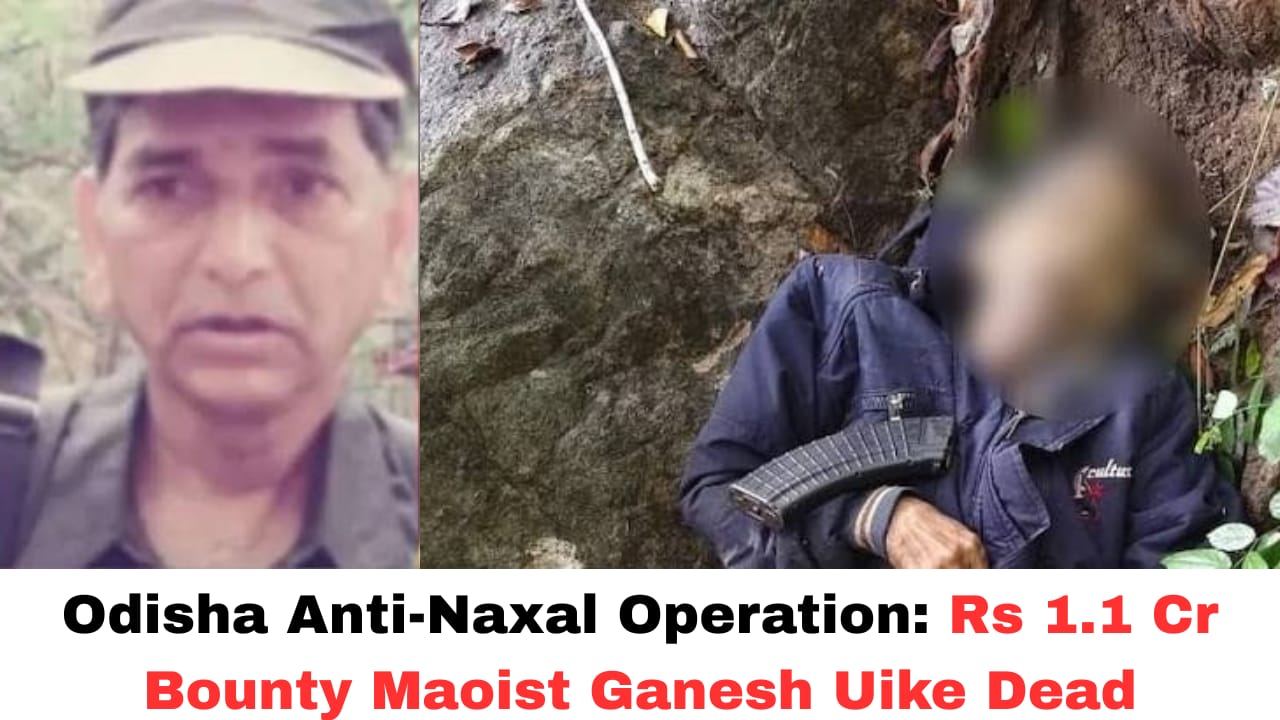
In a significant development in India’s long-running internal security challenge, senior Maoist commander Ganesh Uike, who carried a reward of over Rs 1.1 crore on his head, was killed in an encounter with security forces in Odisha’s Kandhamal district on December 25, 2025. The operation against the banned Communist Party of India (Maoist) was hailed by government officials as a “milestone” in the effort to make the region Naxal-free, reflecting years of sustained counter-insurgency operations.
The gunfight occurred in the Rambha forest range along the Kandhamal–Ganjam border, where a joint force comprising the Odisha Police’s Special Operations Group (SOG), the Central Reserve Police Force (CRPF), and the Border Security Force (BSF) launched a coordinated offensive based on precise intelligence inputs about the presence of Maoist cadres in the area.

Details of the Encounter
The operation began early in the morning when teams of security personnel moved into the dense forest zones under the Chakapad police station limits. Soon after locating a Maoist squad, a fierce exchange of gunfire broke out between the insurgents and the combined forces. By noon, the bodies of four Maoists — including Ganesh Uike — had been recovered from the site, and weapons including two INSAS rifles and a .303 rifle were seized.
Authorities reported that the encounter was intense, reflecting the preparedness of the insurgent group. Along with Uike, three other Maoist members whose identities are yet to be officially confirmed were also neutralised.
In related operations over the past 24 hours, security forces killed six Maoists in total, underscoring the intensity and scale of the ongoing anti-Naxal offensive in the region.
Who Was Ganesh Uike?
Ganesh Uike, also known by aliases such as Pakka Hanumantu, Rajesh Tiwari, Chamru, and Rupa, was a 69-year-old senior commander within the CPI (Maoist) and served as the chief of Maoist operations in Odisha. He was among the few remaining central committee members of the banned organisation, making him one of the most wanted insurgents in the country.
Originally hailing from Pullemala village in Chendur Mandal, Nalgonda district, Telangana, Uike had been active in Maoist operations for more than four decades, with involvement stretching across the Eastern Ghats, particularly in forested belts spanning Odisha, Chhattisgarh, and adjoining areas.
Throughout his insurgent career, he was believed to have played a critical role in planning, recruiting, training, and directing cadres, and was also linked to several deadly attacks on security forces and political figures. While earlier incidents like the Jhiram Ghati massacre of 2013 — where numerous leaders were killed — shook the nation, Uike’s name had long been associated with the violent tactics employed by Maoists across states.
Government Reaction and Strategic Significance
Government leaders, including Union Home Minister Amit Shah, described the operation as a major breakthrough in India’s efforts to eradicate left-wing extremism. In a message posted on social media platform X, Shah stated that with six Maoists, including Uike, neutralised so far, Odisha “stands at the threshold of becoming completely free from Naxalism” and reaffirmed the government’s resolve to eliminate Maoist insurgency by March 31, 2026 — a deadline frequently referenced by security officials.
Officials have credited the success of the operation to the enhanced intelligence-led approach and coordinated efforts among multiple security agencies, an effort that has, over recent years, seen many top Maoist commanders either killed or forced to surrender.
The operation’s success also comes on the heels of a recent surrender of 22 Maoist operatives in neighbouring Malkangiri district, highlighting the dual strategy of using force against hardened cadres while offering rehabilitation for those willing to lay down arms.
Broader Context: India’s Anti-Naxal Strategy
The Maoist insurgency in India, often referred to as left-wing extremism (LWE), has historically been concentrated in the “Red Corridor” — a vast stretch of central and eastern India marked by dense forests, economic underdevelopment, and tribal populations. For decades, the security challenge has involved armed uprisings, ambushes, and attacks on infrastructure, leading to significant loss of life and governance challenges in affected regions.

In recent years, a multipronged approach combining security operations with development initiatives, surrender and rehabilitation incentives, and community engagement has been pursued by both the Centre and state governments. This has led to a steady decline in Maoist strength, with many analysts suggesting that the movement is now significantly weakened compared to its peak in the late 2000s and early 2010s.
The killing of Ganesh Uike is emblematic of this larger strategy’s success: removing veteran commanders with deep organisational roots while cutting off logistical and operational networks that sustained insurgent activity.
Local and National Implications
For Odisha, the encounter marks a significant blow to Maoist infrastructure in a state that, despite progress, has continued to witness sporadic insurgent activity in forested districts like Kandhamal, Malkangiri, and Koraput. Security analysts say that the elimination of a commander of Uike’s stature not only disrupts operational command but also affects morale within the remaining cadres.
Nationally, the development strengthens the narrative that sustained pressure and coordinated execution of the government’s anti-Naxal policy can yield measurable results, inching closer to the expectation of a Maoist-free India.
Conclusion
The death of Ganesh Uike, one of the most wanted Maoist leaders in the country, carries strategic and symbolic weight in India’s ongoing fight against left-wing extremism. With key commanders neutralised and insurgent networks progressively weakening, security forces and policymakers see this as a crucial step toward achieving long-term peace and stability in affected regions. As operations continue and development programmes gain traction, the hope of significantly diminishing the Maoist threat by the government’s targeted timelines appears closer than ever before.
You May Also Read: After 3-Month Halt, Delhi Schools Ordered to Resume Sanitary Napkin Distribution