




Digital News Guru Environment Desk:
A small near-Earth asteroid, named 2026 HJ1, made headlines today after passing close to Earth. Described as “bus-sized,” the space rock attracted global attention and curiosity. While such news can sound alarming, scientists have clarified that the event was completely safe and part of normal cosmic activity.
What Happened Today?
On April 21, 2026, asteroid 2026 HJ1 made its closest approach to Earth. According to observations and NASA data, the object passed at a safe distance of about 643,000 kilometers (around 400,000 miles) from our planet.
Despite being labelled a “close approach,” this distance is actually greater than the average distance between Earth and the Moon. Events like this are tracked carefully, but they are not unusual in astronomical terms. Scientists routinely observe such flybys as part of ongoing space monitoring programs.

Size and Nature of the Asteroid
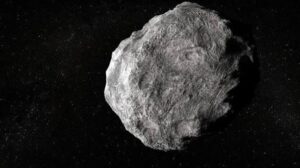
Asteroid 2026 HJ1 is estimated to be about 23 feet wide, roughly comparable to the size of a bus.
It belongs to a category known as Near-Earth Objects (NEOs)—asteroids and comets whose orbits bring them relatively close to Earth. These objects are typically remnants from the early solar system, formed around 4.6 billion years ago, and continue to orbit the Sun.
Although its size sounds significant, in cosmic terms, it is considered quite small. Many similar or even larger objects pass near Earth regularly without posing any threat.
Was There Any Danger?
The most important question people ask in such situations is: Was Earth in danger?
The answer is simple—no. Experts confirmed that asteroid 2026 HJ1 posed zero risk of impact.
Even if a similar-sized asteroid were to enter Earth’s atmosphere, it would most likely burn up due to intense friction before reaching the ground.
Scientists emphasize that for an asteroid to be considered hazardous, it must be significantly larger and follow a trajectory that intersects with Earth’s orbit. This was not the case here.
Why Do Asteroids Come Close to Earth?
Asteroids like 2026 HJ1 follow elliptical orbits around the Sun. Due to gravitational influences from planets and the Sun itself, their paths sometimes cross or come close to Earth’s orbit.
This does not mean they are “heading toward Earth” in a dangerous sense. Instead, it reflects the dynamic and constantly moving nature of our solar system.
In fact, astronomers note that multiple asteroids pass near Earth every month, but most go unnoticed because they are small and far away.
How Scientists Track Such Objects
NASA and other space agencies use advanced telescopes and monitoring systems to track near-Earth objects. These systems can detect asteroids long before they approach our planet.
Programs like NASA’s planetary defense initiative continuously analyze asteroid paths, speeds, and potential risks. This ensures that any object posing a real threat would be identified years—or even decades—in advance.
The tracking of 2026 HJ1 is part of this broader effort to understand and monitor Earth’s cosmic environment.
How Common Are Such Flybys?
Although this event gained attention, it is far from rare. Space agencies regularly record close approaches by asteroids of varying sizes.
For example, in recent weeks alone, scientists tracked several other asteroids—some house-sized or even larger—passing safely by Earth.
These events highlight that Earth exists in a busy region of space, surrounded by countless objects moving in different orbits. However, the vast majority of these encounters are harmless.
Public Reaction and Media Attention
The phrase “asteroid near Earth” often creates concern or panic among the public. Words like “monster” or “close flyby” can make the situation sound more dangerous than it actually is.
In reality, experts stress that such events are routine and well-understood. The attention surrounding asteroid 2026 HJ1 reflects growing public interest in space rather than an actual threat.

The Bigger Picture: Planetary Safety
While this particular asteroid was harmless, monitoring near-Earth objects remains extremely important. Larger asteroids have impacted Earth in the distant past, and studying smaller ones helps scientists improve detection and response strategies.
Ongoing research and tracking efforts ensure that humanity is better prepared than ever before. With current technology, any potentially dangerous object would likely be detected long in advance.
Conclusion
The flyby of asteroid 2026 HJ1 is a reminder of the dynamic nature of our solar system. Despite dramatic headlines, the event posed no danger to Earth and was simply another example of a routine cosmic encounter.
Such घटनाएँ (events) not only deepen our understanding of space but also highlight the effectiveness of modern scientific monitoring systems. Rather than a cause for concern, this asteroid flyby is an opportunity to appreciate the vast and fascinating universe around us.
You May Also Read: Riteish Deshmukh’s Raja Shivaji Trailer Wins Fans with ‘Ek Maratha Lakh Maratha’ Chant