



Digital News Guru International Affairs Desk:
U.S. Slaps 25 % Tariff on Iran’s Trading Partners
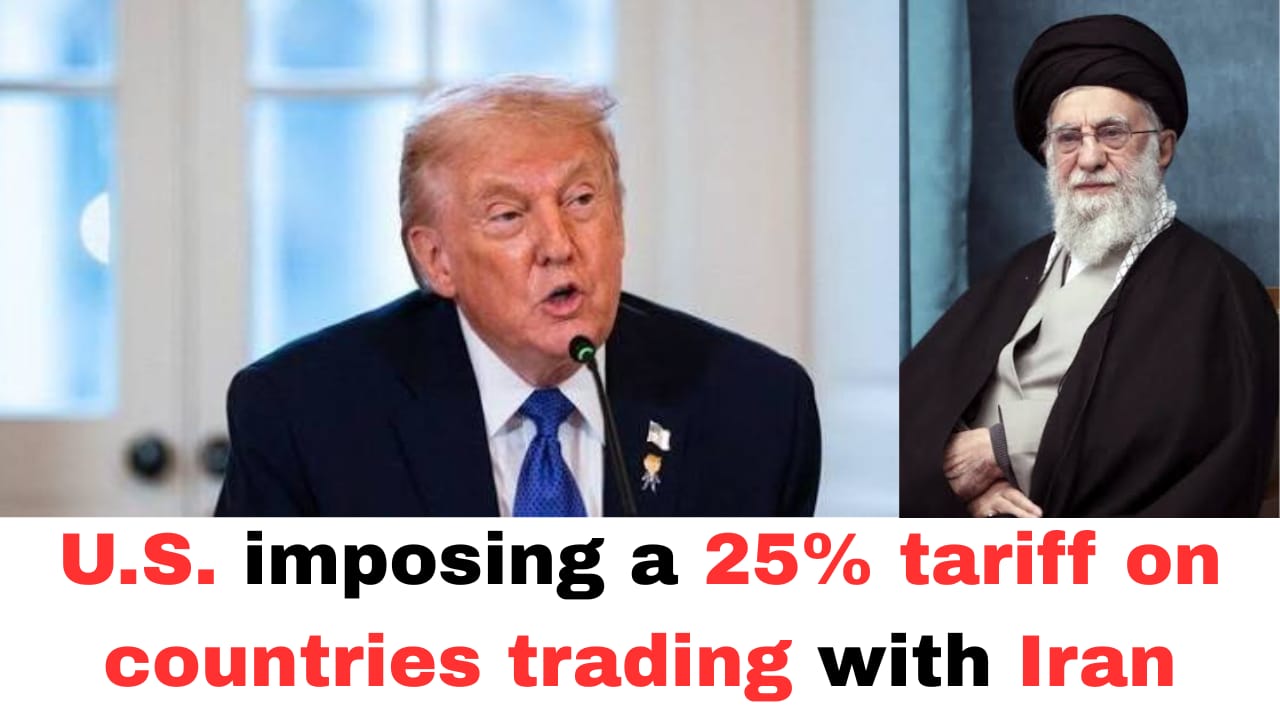
In a striking escalation of economic pressure on Iran, U.S. President Donald Trump announced on January 12, 2026, that any country doing business with the Islamic Republic of Iran will face a 25 % tariff on all trade with the United States. The declaration, posted on his social media platform Truth Social, was made without detailed accompanying documentation, signaling a politically charged and unilateral expansion of American trade policy.
Trump’s move represents a dramatic extension of longstanding sanctions on Tehran, shifting from targeting specific Iranian entities and sectors to penalizing entire nations that maintain commercial ties with the country. According to the announcement, this tariff is “effective immediately” and applies broadly to any country that continues trade links with Iran, ranging from agricultural exports to energy and manufactured goods.
Broader Geopolitical Context
The tariff comes amid one of the most tumultuous periods in Iran’s recent history. The country has been rocked by widespread anti-government protests — some of the largest since the 1979 revolution — sparked by social and economic grievances. Reports suggest hundreds of civilians have died in the unrest, drawing international condemnation of Tehran’s response.
U.S. officials have framed the tariff as part of a broader strategy to isolate Iran economically and compel reforms. White House spokespeople have indicated that “all options are on the table”, including diplomatic avenues but not excluding potential military actions if Iran continues its crackdown.
However, legal experts and global commentators have noted that Trump’s method of imposing such a sweeping tariff without clear statutory backing raises serious constitutional and international trade law questions. The U.S. Supreme Court is reportedly reviewing previous tariff measures under the International Emergency Economic Powers Act (IEEPA), raising uncertainty about the new tariff’s legal legitimacy and enforcement.
Global Economic Reactions and Tensions
The announcement has reverberated across global markets and diplomatic circles. China, Iran’s largest trading partner — responsible for roughly 77 % of Tehran’s oil exports in 2024 — immediately criticized the tariff, labeling it coercive and threatening retaliation. Other nations with substantial economic ties to Iran, including Turkey, the UAE, and Japan, have pleaded for clarity on the policy’s implementation and potential exemptions.
Financial markets have shown signs of volatility in response. Oil prices surged, as traders factored in the geopolitical risk premium tied to the sanctions and broader Middle East tensions. Additionally, uncertainty over trade enforcement and possible retaliatory measures has introduced new risk calculations for commodities and currency markets.
Critics — including economists and former International Monetary Fund officials — warn that such tariffs might hurt U.S. consumers by raising production costs and import prices while failing to fundamentally change Iranian domestic policies. They argue that Tehran’s economy has shown resilience under sanctions and that expanded punitive measures could entrench hard-line positions rather than encourage reforms.
Impact on India: Minimal but Not Irrelevant
For India, the 25 % tariff move has produced a mixture of reassurances and caution. Government sources in New Delhi have indicated that the new tariff is unlikely to have a major impact on India’s trade, primarily because bilateral trade with Iran has been relatively limited in recent years. Iran does not rank among India’s top 50 trading partners, and total bilateral trade stood at around $1.6 billion in 2024–25, representing roughly 0.15 % of India’s total trade volume.
Officials have also stressed that much of India’s existing commerce with Iran falls into humanitarian categories, such as food items and pharmaceuticals, which are typically permitted even under U.S. sanctions frameworks. The Federation of Indian Export Organisations (FIEO) has echoed this assessment, suggesting that Indian exporters have largely complied with the U.S. Office of Foreign Assets Control (OFAC) norms and that additional tariffs would “almost have no impact” on India’s trade flows.
Nevertheless, some Indian sectors have expressed concern, particularly agriculture. Iran has historically been a significant market for Indian basmati rice, and recent reports indicate that rice shipments have stalled amid export payment uncertainties and the broader economic crisis in Iran. Exporters fear that the tariff could reinforce those market disruptions, even if the tariff does not directly apply to Indian goods.
There are also strategic considerations. India’s involvement with Iran’s Chabahar port — a key piece in New Delhi’s connectivity strategy to Afghanistan and Central Asia — has long been facilitated through waivers from U.S. sanctions. Analysts note that the new tariff regime could complicate such arrangements if Washington chooses to tighten enforcement or let existing waivers lapse.
Legal Ambiguities and Future Uncertainties
One of the most contentious aspects of the new tariff policy is the lack of formal documentation or clarity on enforcement mechanisms. Although Trump declared the tariff order “final and conclusive,” there has been no official posting on the White House or U.S. Trade Representative websites detailing the legal authority, scope, or timeline for implementation.
Experts note that the effectiveness of such a tariff — especially as a tool to change geopolitical behavior — depends heavily on how it is enforced in practice, what exemptions are allowed, and how trading partners choose to respond. Without clear rules, the tariff risks creating confusion in global markets and could prompt a wave of diplomatic negotiations as countries seek carve-outs or assurances.
Conclusion
The announcement of a 25 % tariff on countries trading with Iran marks a significant escalation in the United States’ economic strategy toward Tehran. While intended to exert pressure and signal resolve amid Iranian unrest, the measure has sparked international criticism, market volatility, and legal controversy. For India, the direct impact may be limited, but broader ramifications — from agricultural exports to strategic infrastructure projects — mean that policymakers and businesses alike are watching closely as the situation unfolds.
You May Also Read: India Beat New Zealand by 4 Wickets in First ODI at Vadodara — Match Report & Highlights