



Digital News Guru West Bengal Desk:
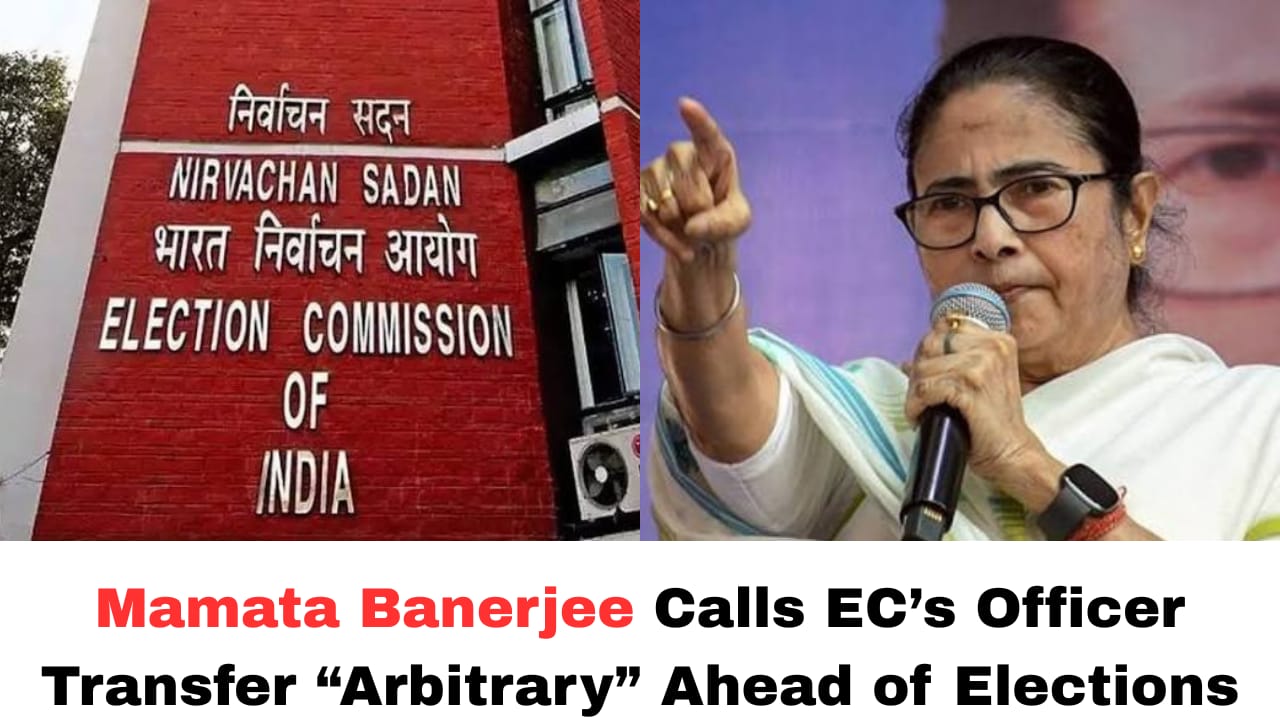
The political atmosphere in West Bengal has intensified sharply ahead of the 2026 Assembly elections, as Chief Minister Mamata Banerjee has raised strong objections to the Election Commission of India (ECI) over its decision to remove and transfer several top state officials. The controversy has triggered a wider debate on federalism, electoral neutrality, and the balance of power between elected governments and constitutional bodies.
The issue began soon after the Election Commission announced the schedule for the West Bengal Assembly elections, which are set to be held in two phases on 23 and 29 April 2026, with counting on 4 May. Almost immediately after the announcement, the Commission ordered a sweeping administrative reshuffle in the state. Key officials—including the Chief Secretary, Home Secretary, Director General of Police (DGP), and Kolkata Police Commissioner—were replaced or transferred.

What the Election Commission says
According to the Election Commission, such measures are part of standard procedure to ensure that elections are conducted in a free, fair, and impartial manner. By reshuffling top officials, the Commission aims to prevent any perceived bias or undue influence of the ruling party over the administrative machinery during elections. This step is rooted in the Model Code of Conduct, which comes into force immediately after election dates are announced.
Why Mamata Banerjee is opposing it
However, Mamata Banerjee has strongly opposed the move, calling it “arbitrary,” “unilateral,” and unprecedented. In a letter to the Chief Election Commissioner, she expressed “deep concern and surprise” over the sudden transfers, arguing that the state government was not consulted before such major decisions were taken. She further described the reshuffle as a “midnight mayhem,” indicating that the timing and manner of the decision raised serious questions.
One of the most contentious aspects of the controversy is the removal of Nandini Chakravorty, who had recently become West Bengal’s first woman Chief Secretary. Banerjee criticized this move as “anti-women” and “anti-Bengali,” suggesting that it undermined both regional representation and gender inclusion in governance. The Chief Minister has also alleged that the Election Commission’s actions may be politically motivated, hinting at bias in favor of opposition forces.
The ruling Trinamool Congress (TMC) has echoed Banerjee’s concerns, even staging protests and walkouts in Parliament against the Commission’s decision. Critics within the party argue that while the EC does have constitutional authority, its powers should not be exercised in a manner that appears to interfere with the functioning of an elected state government.
Broader Implications
On the other hand, the Election Commission and the central government have defended the reshuffle. Supporters of the move argue that such transfers are necessary to maintain neutrality and prevent any misuse of administrative power during elections. They emphasize that similar actions have been taken in other states in the past and are not unique to West Bengal.
This confrontation highlights a recurring tension in Indian democracy: the balance between state autonomy and the authority of central institutions. While the Election Commission is an independent constitutional body entrusted with ensuring free and fair elections, state governments often view such interventions as encroachments on their administrative control.
Why this is a big deal
The timing of the controversy is particularly significant. West Bengal is politically crucial, with the ruling Trinamool Congress seeking to retain power against a strong challenge from opposition parties. In such a charged environment, even routine administrative decisions can take on political overtones.
Moreover, the episode raises broader questions about the perception of institutional neutrality. For elections to be credible, not only must they be fair, but they must also appear fair to all stakeholders. When major political actors publicly question the decisions of the Election Commission, it can impact public trust in the electoral process.

At the same time, it is important to recognize that the Election Commission’s powers are derived from the Constitution, and it has historically exercised wide authority to ensure unbiased elections. The challenge lies in striking the right balance—ensuring neutrality without appearing heavy-handed or partisan.
In conclusion, the ongoing dispute between Mamata Banerjee and the Election Commission is more than just a disagreement over bureaucratic transfers. It reflects deeper issues related to democratic governance, institutional trust, and political competition. As West Bengal heads into a crucial election, how this conflict unfolds will not only shape the state’s political landscape but also influence the broader discourse on electoral integrity in India.
You May Also Read: Delhi Approves Mega Road & Flyover Projects to Boost Connectivity