



Digital News Guru Tamil Nadu Desk:
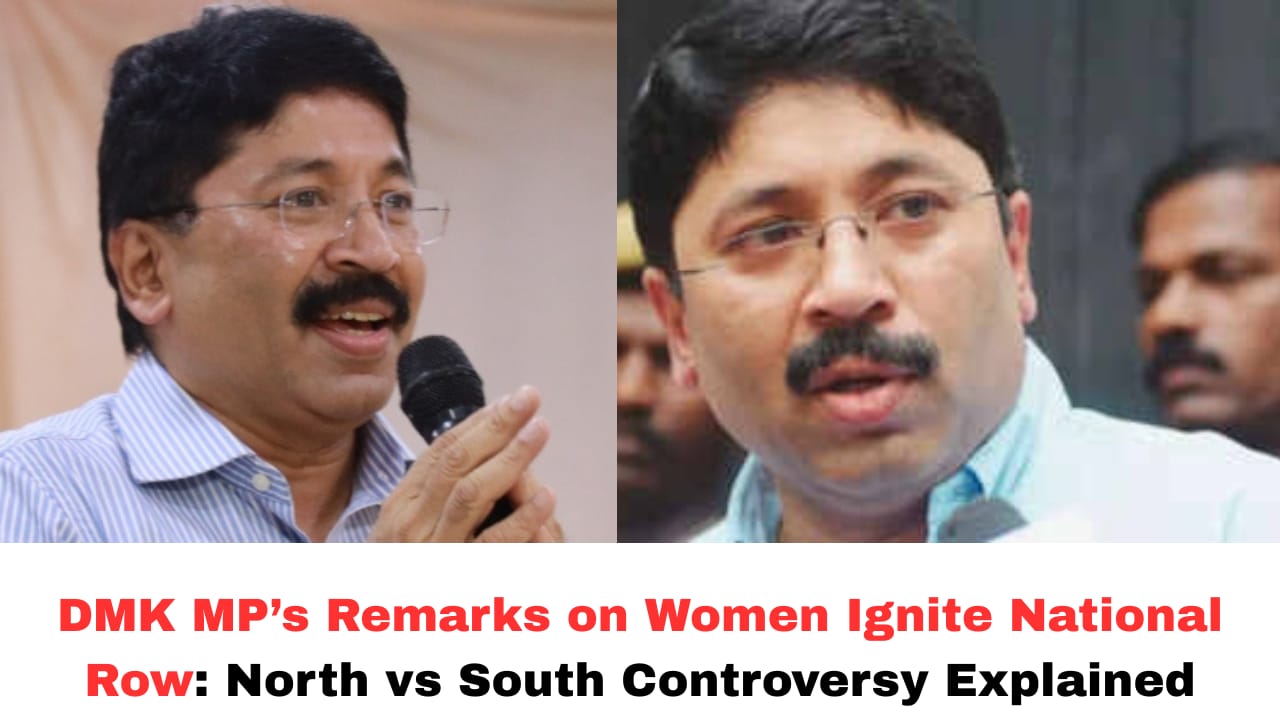
A seemingly routine address at a women’s college in Chennai turned into a nationwide political controversy after DMK Member of Parliament Dayanidhi Maran made remarks contrasting the roles and status of women in North India with those in Tamil Nadu. The comments, intended to highlight regional differences in women’s education and empowerment, have instead ignited a heated debate about regional stereotyping, gender equality, and political discourse in India.
DMK MP’s Controversial Comparison
Speaking at the Quaid-E-Millath Government College for Women in Chennai, Dayanidhi Maran — a four-time MP from Chennai Central — praised Tamil Nadu’s record on women’s education and empowerment, commending state welfare initiatives, particularly the distribution of laptops and the emphasis on higher education. Maran contrasted this with what he described as prevailing social attitudes in many northern states, where, he said, girls are often encouraged to stay at home, focus on household chores, and bear children rather than pursue education and careers.
Maran’s exact phrasing asserted that in Tamil Nadu, “we ask girls to study and study,” while in parts of North India, women are told “don’t go to work, be at home, be in the kitchen, bear a child, that’s your job.” He tied these remarks directly to the Dravidian socio-political ethos, crediting leaders such as former ministers Karunanidhi and Annadurai for creating a culture that values women’s progress.
The event where the remarks were made also saw the Deputy Chief Minister of Tamil Nadu, Udhayanidhi Stalin, distribute laptops to 900 final-year students under the Ulagam Ungal Kaiyil (The World in Your Hands) scheme — an initiative aimed at supporting women’s education with technology. These state-led welfare programs are widely promoted as part of the DMK government’s agenda to improve gender parity in education and employment.
Political Fallout and Backlash
Almost immediately after Maran’s speech was published and widely circulated on social media and news platforms, politicians from outside Tamil Nadu, particularly from the Bharatiya Janata Party (BJP), strongly condemned the comments.
BJP leader Narayanan Thirupathy demanded a public apology, especially to Hindi-speaking communities, accusing Maran of failing to show “common sense” and portraying people from northern states as uneducated and uncivilised. “I strongly condemn his comments. He must apologise to the people of India,” Thirupathy said in a statement.
Another BJP leader, Anila Singh, called the remarks “unfortunate,” stressing that India’s cultural fabric unites the country across regions and that demeaning entire communities is unacceptable. She pointed out that women from across India, including the north, excel in various fields and play significant roles in governance and industry.
The controversy quickly spread beyond political circles into broader public discourse. Many commentators argued that while highlighting women’s empowerment is important, making broad regional generalisations about women’s roles based on geography risks deepening regional divides and inflaming social tensions. Critics also suggested that such statements shift focus away from constructive discussions on gender equality toward divisive identity politics that can polarise public opinion.
DMK’s Defense and Supporters’ View
In response to the criticism, some leaders within Maran’s own Dravida Munnetra Kazhagam (DMK) defended his remarks, claiming that his intention was to motivate and celebrate the progress of women in Tamil Nadu rather than to denigrate other regions. DMK spokespersons highlighted that Tamil Nadu’s female literacy and workforce participation have generally outpaced many northern states, attributing this to long-standing social reform movements and progressive policies that promote education for all.
Supporters also pointed out that discussions about social and educational disparities between states are not new in Indian politics, arguing that examining such differences can be a starting point for addressing systemic inequalities. From this perspective, the remarks were framed as regional pride and advocacy for women’s rights, albeit expressed in a controversial way.
Broader Debates on Gender and Regional Identity
The episode has sparked a wider conversation about how regional identity intersects with discussions on gender equality in India. Northern and southern states have historically displayed different social dynamics shaped by cultural, economic, and political histories. Tamil Nadu’s political landscape, for instance, has long been influenced by Dravidian movements emphasizing social justice, education, and secular values, which have contributed to measurable gains in literacy and women’s participation in the workforce.
However, critics of Maran’s statement argue that using generalized regional comparisons can obscure the complex realities faced by women across India. Gender inequality is a pervasive issue nationwide, with challenges that vary by community, economic status, caste, and locality — not simply by north–south dichotomy. Many social justice advocates assert that progress in one region should not be touted at the expense of another, and that emphasis should instead be placed on learning from best practices and collaborative policymaking.

Implications for Political Discourse Ahead of Elections
The timing of this controversy is also politically significant. With state and national elections on the horizon, remarks that evoke regional sentiments are likely to become fodder for political campaigns. Opposition parties see an opportunity to challenge the DMK’s narrative and appeal to voters who may feel slighted by such comparisons, while DMK leaders may aim to reinforce regional pride and mobilize their base by highlighting achievements in women’s empowerment.
Political analysts say that controversies like this can both energise and polarise voters, depending on how parties navigate the ensuing discourse. While some voters may resonate with calls for highlighting social progress, others may react negatively to statements perceived as divisive or dismissive of the broader Indian populace.
Conclusion
Dayanidhi Maran’s remarks have brought to the forefront conflicting yet interconnected debates about women’s empowerment, regional identity, and political rhetoric in India. While the intention to advocate for women’s education and opportunities is widely supported, the method of framing that message — especially through broad regional comparisons — has generated significant backlash. As the political landscape evolves, this controversy is likely to remain a talking point, highlighting the challenges of balancing regional pride with national unity in India’s vibrant democratic dialogue.
You May Also Read: Uttarayani Kauthig Festival Begins in Lucknow: 15 Day Cultural Celebration Launched