



Digital News Guru New Delhi Desk:
Air India A350 Engine Damage at Delhi Airport
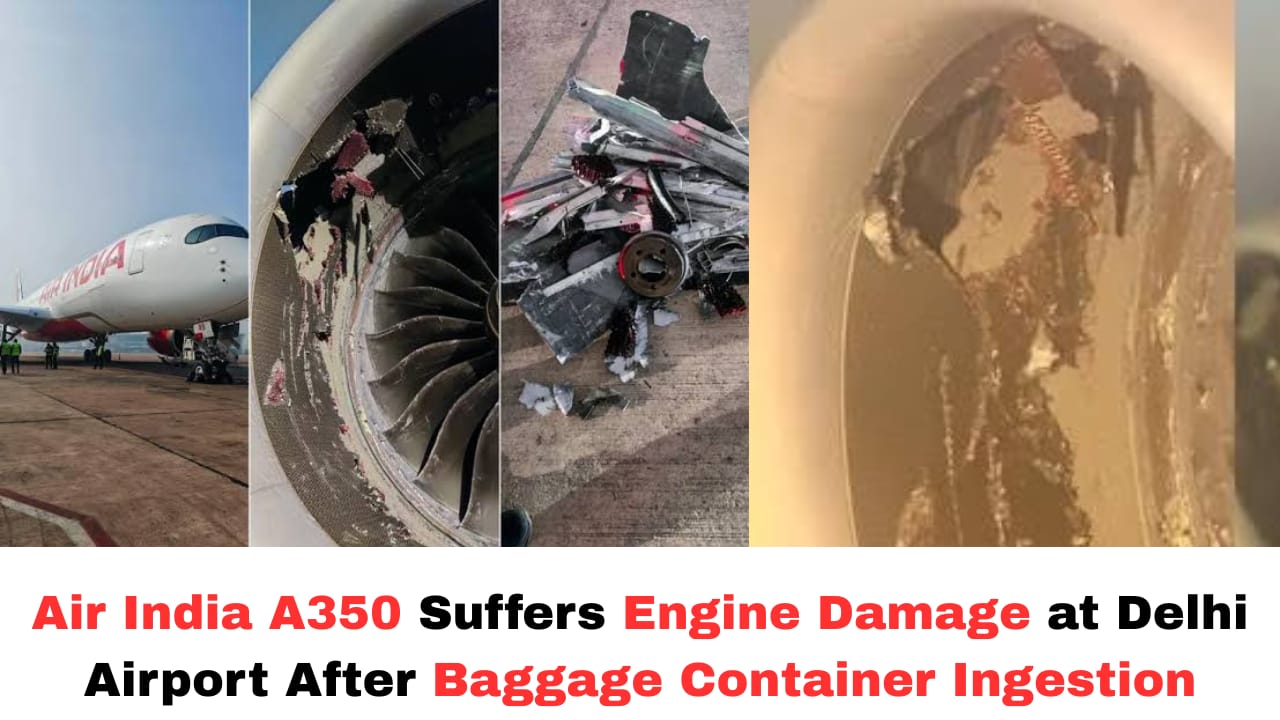
On 15 January 2026, a routine long-haul Air India flight turned into a rare aviation incident when one of its engines was seriously damaged on the ground at Indira Gandhi International Airport (IGIA), New Delhi. The event, which saw a baggage container being sucked into an Airbus A350’s engine while taxiing, has triggered both an aviation safety probe and operational concerns for the airline.
Flight AI101: From Early Morning Departure to Sudden Turnaround
The aircraft involved, an Airbus A350-900 (registration VT-JRB), was operating as Flight AI101 on the Delhi–New York (JFK) route. The flight took off from Delhi in the early hours of the morning (around 2:36 am IST) with more than 250 passengers on board.
Shortly after departure, the flight crew received advisory information that Iranian airspace — a critical transit corridor for westbound long-haul flights — had been abruptly closed due to geopolitical tensions. This unexpected closure forced the aircraft to return safely to Delhi less than three hours after takeoff.
The unscheduled return itself was unusual but not dangerous; what followed on the ground was far more remarkable.
Dense Fog and a Misplaced Container: A Sequence of Unfortunate Events
After landing back at IGIA and clearing the runway to taxi toward its designated parking bay, the A350 encountered a foreign object on the taxiway in dense foggy conditions. According to preliminary findings from the Directorate General of Civil Aviation (DGCA), a baggage container being transported by ground staff toppled onto the taxiway when a wheel from its tug vehicle came off.
The container fell just ahead of the A350’s taxi path, and due to the morning’s low visibility and the powerful suction effect of a jet engine even at taxi speed, it was ingested into the aircraft’s right-side engine (Engine No. 2).
This type of foreign object ingestion is rare but serious: jet engines are designed to draw in massive amounts of air, and when they instead pull in solid objects, the spinning fan blades and internal components can suffer significant damage.
No Injuries, But a Significant Impact
Fortunately, no passengers or crew members were injured during the incident. The aircraft had already landed and was moving relatively slowly on the ground when the event occurred, and the flight was safely brought to a stop at the designated parking stand.
Air India confirmed that the incident happened after landing and that all on board were safe. However, the damage to the engine has taken the aircraft out of service temporarily. The airline also warned that this could result in disruptions to some of its A350-operated long-haul routes, particularly those to New York, London, and Newark — destinations that rely heavily on the airline’s A350 fleet.
Investigation Underway: DGCA and Safety Protocols Scrutinized
The DGCA has launched a formal investigation to determine exactly how the baggage container came to be on the taxiway during active ground movement and whether airport ground-handling procedures were properly followed.
According to the regulator’s preliminary assessment, the container was being moved by a BWFS (Bird Worldwide Flight Services) tug toward a designated parking area when the wheel malfunction occurred, causing the container to topple.
Normally, strict ground-handling safety protocols are in place to ensure that equipment such as baggage dollies and cargo containers remain well outside the risk zones of active taxiways, especially when aircraft engines are running. The DGCA’s probe will look closely at whether these protocols were followed, and what systemic changes might be needed to prevent a repeat incident.
Ground-handling lapses near moving aircraft are not unprecedented, but the combination of dense fog, heavy engine suction, and a foreign object ended up causing an incident that could have ended very differently. The episode has renewed discussions in aviation safety circles about visibility conditions and coordination between tower operations and ground staff.
Operational and Financial Consequences
For Air India, the incident compounds existing operational challenges. The A350 is a critical part of the airline’s fleet, particularly on long-haul international routes where demand and yields tend to be higher. With one of its six A350s now sidelined for inspection and repair, the airline will have to shuffle aircraft assignments and possibly cancel or delay flights.

Engine repairs — especially after foreign object ingestion — are not simple. Depending on the extent of internal damage, the engine may require extensive overhaul, part replacements, or even a full engine swap, which involves coordination with the engine manufacturer and maintenance facilities. Such processes can take weeks or longer, especially for high-bypass turbofan engines like those on the A350.
Additionally, the flight’s initial disruption due to the closure of Iranian airspace underscores how external geopolitical events can compound operational stress for airlines, forcing reroutes that increase flight times, fuel costs, and scheduling complexity.
What This Means for Passengers and the Industry
In the immediate term, affected passengers are being offered rebooking options, refunds, or alternative travel arrangements as preferred. Air India has expressed regret over the inconvenience and emphasized that passenger safety remains its top priority.
For the broader aviation industry in India, the incident serves as a reminder of the importance of seamless coordination between air traffic control, pilots, ground handlers, and weather monitoring systems. Dense fog — a common challenge in North India during winter — has for decades been a factor in flight delays and cancellations. However, this episode highlights how combined environmental and human-factor issues can escalate into serious aircraft damage.
As the DGCA completes its investigation, stakeholders will be watching for any new safety recommendations or changes in ground operations standards at IGIA and other major hubs. The goal, industry experts say, should be not only to understand what went wrong this time, but also to ensure it doesn’t happen again.
You May Also Read: Karan Patel Becomes First Confirmed Contestant on Reality Show “The 50”