



Digital News Guru Uttar Pradesh Desk:
UP Government Simplifies RTE Admissions
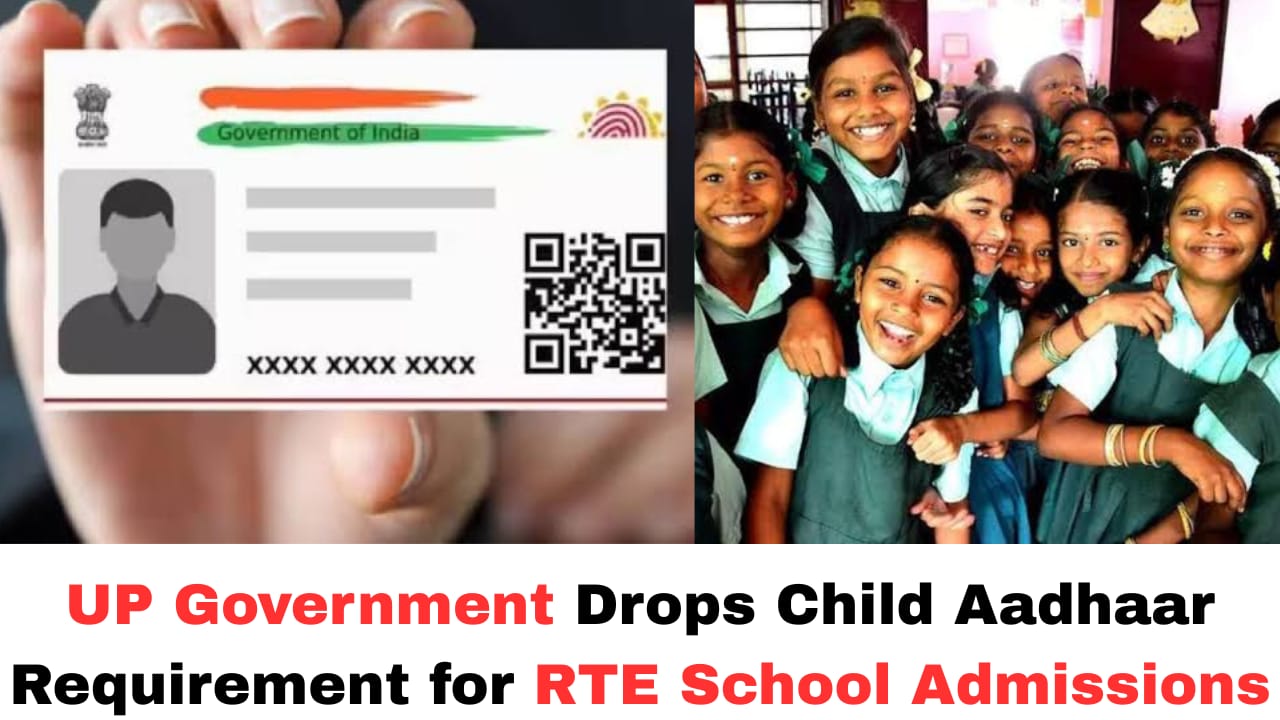
In a significant move aimed at making education more accessible for economically weaker and disadvantaged families, the Uttar Pradesh government has announced a major change in the school admissions process under the Right of Children to Free and Compulsory Education (RTE) Act, 2009. The state has removed the mandatory requirement of Aadhaar cards for children applying under the RTE quota in private schools, marking a shift toward greater inclusivity in education.
Background: What is the RTE Act?
The RTE Act, enacted by the central government, guarantees free and compulsory education for all children between the ages of 6 and 14 years. A key provision under Section 12(1)(c) requires that 25 % of seats in unaided private schools be reserved for children belonging to economically weaker sections (EWS) and disadvantaged groups. This reservation is intended to help such children receive quality education alongside their peers in private institutions.

What Changed in the Admission Rules?
The latest policy revision, issued by the Uttar Pradesh Basic and Secondary Education Department, simplifies the documentation requirements for RTE admissions:
- Aadhaar Not Mandatory for Children: Previously, the Aadhaar card of the child was required to complete the RTE application. This requirement has now been removed, easing the process for families who may face difficulty obtaining or updating their child’s Aadhaar card.
- Only One Parent’s Aadhaar Needed: While the child’s Aadhaar is no longer compulsory, parents must provide at least one parent’s Aadhaar card number when submitting the online application.
- Financial Aid Linked to Aadhaar: Government financial assistance or reimbursement related to RTE admissions will continue to be transferred only to Aadhaar-linked bank accounts of parents. This step maintains accountability and transparency in fund disbursement.
This policy change aims to eliminate unnecessary documentation barriers that previously discouraged or prevented genuinely eligible families from participating in the RTE lottery system.
How the New Admission Process Works
The RTE admission process in Uttar Pradesh for private schools will continue to follow a transparent and structured system, even after these changes:
- Eligibility & Age Criteria:
- Children aged 3–4 years are eligible for nursery classes.
- Those aged 4–5 years can enroll in Lower Kindergarten (LKG).
- Ages 5–6 years qualify for Upper Kindergarten (UKG).
- Children between 6 and 7 years are eligible for Class 1 admissions.
This ensures that age groups align uniformly with the prescribed entry levels across schools.
- Verification of Documents:
Document verification is conducted at the grassroots level by Block Education Officers and Basic Shiksha Adhikaris. These officers check eligibility and supporting documents before a child’s name is included in the lottery pool. - Online Lottery Allocation:
After verification, the school allocation process is managed through an online lottery system conducted in two stages:- Randomisation: Applications are randomly shuffled and assigned lottery numbers.
- Allotment: Applicants are placed in schools based on their preferences and lottery ranks.
The final list is then approved by the District Magistrate, ensuring fairness and preventing manipulation.
- District-wise Admission Quotas:
Each district is assigned an annual admission target determined by 25 % of the total capacity of entry-level classes in all unaided private schools within that district.

Why This Change Matters
The policy revision represents an important administrative response to challenges faced by underprivileged families:
- Reduces Documentation Barriers: Many families, especially in rural areas, struggle to obtain and update Aadhaar cards, particularly for young children. Removing this mandatory requirement simplifies the process and encourages more applications.
- Supports Educational Inclusion: By relaxing documentation norms, the government aims to ensure that children from disadvantaged backgrounds are not excluded from educational opportunities due to bureaucratic hurdles.
- Aligns with RTE’s Intent: Officials have reiterated that this change is in “line with the spirit of the RTE Act”, which seeks to provide equitable access to education for all children irrespective of socio-economic constraints.
Official Response and Implementation
According to officials, the revised guidelines were issued to all District Magistrates—who also serve as presidents of District Education Project Committees—to ensure consistent implementation across the state. District authorities are responsible for overseeing the entire admission cycle, from verification to lottery allocation.
Education department sources emphasize that the policy revision will not only streamline the application process but also encourage more families to seek admissions under the RTE quota, particularly those who may have previously hesitated due to documentation requirements.

Looking Forward: What Parents Should Know
For parents and guardians planning to apply under the RTE quota in the current or upcoming academic sessions:
- Prepare minimal documentation: Only one parent’s Aadhaar is required for the application form, while the child does not need to have an Aadhaar number.
- Link bank accounts: Financial assistance under the RTE scheme will be transferred to Aadhaar-seeded bank accounts, so ensuring that Aadhaar details are correctly linked to bank accounts remains crucial.
- Stay updated on age criteria: Parents must check the child’s age eligibility as per the prescribed age ranges to ensure they qualify for the correct entry level.
- Follow the online process: The entire RTE admission process is designed to be online and transparent, reducing the risk of nepotism or favor.
Conclusion
The Uttar Pradesh government’s decision to remove the mandatory Aadhaar requirement for children’s admissions under the RTE Act marks a noteworthy step toward inclusive education reform. By easing procedural barriers and simplifying documentation, the state aims to ensure that every eligible child has a fair chance to access quality education, especially those from economically weaker and disadvantaged families. As the policy rolls out, authorities hope that more families will be encouraged to participate in the RTE process, ultimately bringing more children into mainstream education and contributing to long-term social development.
You May Also Read: New Delhi World Book Fair 2026 Opens in Delhi