



Digital News Guru Maharashtra Desk:
Shiv Sena (UBT) and MNS Join Forces Ahead of BMC Elections
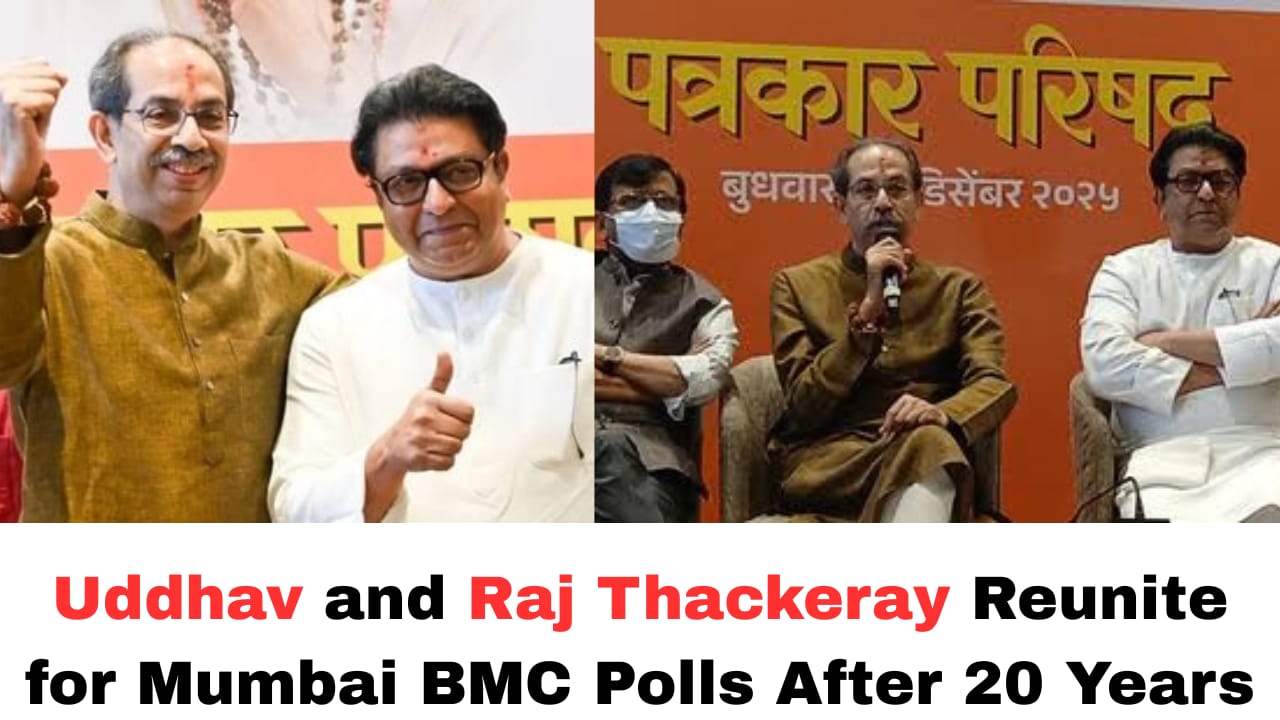
In a landmark political development in Maharashtra’s civic politics, Shiv Sena (UBT) chief Uddhav Thackeray and Maharashtra Navnirman Sena (MNS) leader Raj Thackeray announced on 24 December 2025 that their parties will contest the upcoming Brihanmumbai Municipal Corporation (BMC) elections together — ending a two-decade feud and reshaping the political landscape of India’s richest civic body. The elections are scheduled for 15 January 2026, with results to be declared shortly thereafter.
Reunion of the Thackeray Cousins After 20 Years
Uddhav and Raj Thackeray, cousins who had been politically estranged since 2006 when Raj split from the original Shiv Sena to form the MNS, stood side by side at a joint press conference in Mumbai to formalise their alliance for the BMC polls. The announcement came as months of speculation and behind-the-scenes negotiations finally culminated in a political partnership aimed at consolidating the Marathi vote and strengthening regional political power.
Addressing the media, Raj Thackeray emphasised that the alliance reflects a shared commitment to Marathi identity and civic governance, asserting that the coalition intends to ensure that Mumbai’s next mayor will be a Marathi leader from their alliance. Uddhav echoed this sentiment and highlighted the symbolic unity of the two parties, noting that “we have come together to stay together,” underlining the enduring nature of this political cooperation.
Prior to the announcement, both leaders paid tribute at the Shivaji Park memorial, honouring Bal Thackeray, the founder of the original Shiv Sena, as a symbolic gesture of unity and shared historical roots.
Alliance Strategy and Seat Sharing
While initial press statements did not immediately disclose the full seat-sharing arrangements, sources indicate that the two parties have agreed on a formula for the BMC polls. According to multiple reports, Shiv Sena (UBT) will contest around 145–150 of the 227 seats in the Brihanmumbai Municipal Corporation, while the MNS will field candidates in approximately 65–70 wards. The final distribution varies across sources but reinforces the intention to optimise both parties’ strengths.
In addition to Mumbai, this cooperation is expected to extend to other municipal corporations across Maharashtra, including Nashik, Thane, Kalyan–Dombivli, Mira–Bhayander and Pune, where coordinated efforts between Shiv Sena (UBT) and MNS are underway for the January 15 municipal elections.
The strategic alliance also includes discussions to appeal to broader voter groups, including Muslim and Marathi populations, which together constitute significant portions of the electorate in urban civic bodies. Political observers see this coalition as a tactical move to bridge divides and present a unified front against rival political formations.
Political Context and Stakes
The Brihanmumbai Municipal Corporation — responsible for civic services in one of India’s largest and most influential cities — has long been a political stronghold of the Shiv Sena. However, in recent years, the Bharatiya Janata Party (BJP) and its allied factions have made inroads into the BMC, challenging traditional regional dominance. Critics of the new alliance argue that the BJP, along with its allies in the Mahayuti coalition, remains a formidable opponent and may retain strong electoral support.
Despite these challenges, the Shiv Sena (UBT)–MNS alliance aims to revitalise its base by appealing to Marathi pride and emphasising local identity and civic issues. The alliance also positions itself as a counter-weight to national parties seeking influence in local governance, particularly as Maharashtra’s municipal elections take place against broader state and national political currents.
Reactions and Political Responses
The announcement drew varied reactions across political circles. Leaders from the Congress Party — long part of Maharashtra’s opposition landscape — responded by highlighting governance concerns and calling for inclusive civic development, while critics within other parties downplayed the potential electoral impact of the alliance.
Conversely, BJP representatives have stated that the alliance between Shiv Sena (UBT) and MNS will not significantly alter the outcome of the BMC elections, asserting that voter sentiment remains firmly with the Mahayuti coalition. These remarks underscore the competitive tone of the campaign that is likely to unfold in the coming weeks.
The Legacy and Future Impact
For political observers, the reunion of Uddhav and Raj Thackeray marks one of the most significant developments in regional politics in recent years. It not only signifies a reconciliation of two major Marathi political forces but also highlights the evolving landscape of local governance and identity politics in India’s urban contexts.
The alliance revival also resonates with Maharashtra’s long-standing Marathi manoos (Marathi person) narrative — a cultural and political sentiment that has driven regional movements and influenced voter behaviour for decades. By joining forces, the Shiv Sena (UBT) and MNS are banking on this narrative to reaffirm their relevance and resonate with voters who balance concerns of local governance, civic services, and cultural identity.
What to Expect Next
As the BMC elections on 15 January 2026 draw closer, campaign strategies, candidate lists, and public messaging from the Shiv Sena-MNS alliance are expected to take center stage. The alliance will need to mobilise party workers, delineate clear policy platforms, and engage voters on issues ranging from infrastructure, sanitation, housing, transportation, to community representation and local employment.
Further developments may also influence allied political parties and opposition strategies, potentially reshaping coalitions beyond Mumbai to other key civic bodies across Maharashtra. With just weeks to go before voting day, the political stakes remain high, and the Thackeray alliance could either mark a formidable resurgence of regional politics or face stiff contests from well-organised rivals.
You May Also Read: ISRO successfully launched the BlueBird Block-2 satellite