



Digital News Guru Lucknow Desk:
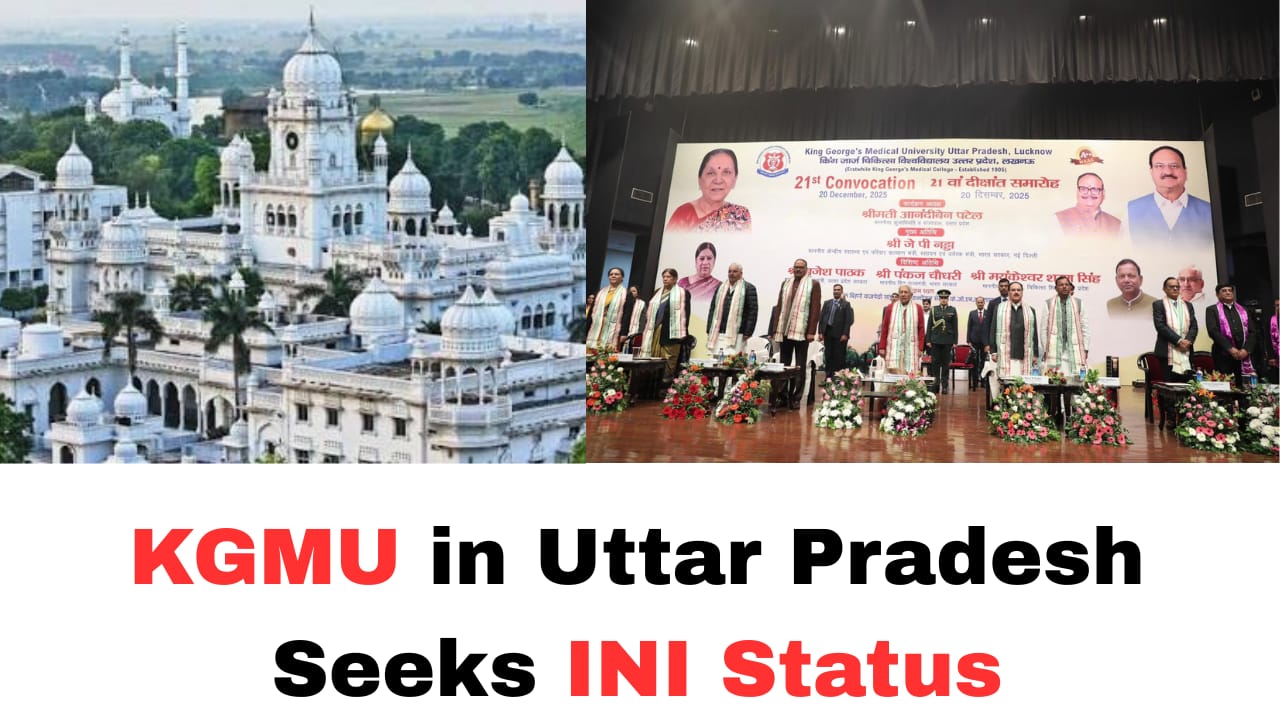
At the 21st convocation ceremony of King George’s Medical University (KGMU) in Lucknow, a strong call was made by political and health leaders for the institution to be elevated to the prestigious Institute of National Importance (INI) status — a designation that would significantly boost its role in medical education, research, and advanced healthcare delivery across India.
Advocacy from the Top: Union Minister Backs INI Status
Union Minister and Uttar Pradesh BJP Chief Pankaj Chaudhary took centre stage at the convocation, urging the Union Health Ministry to consider granting INI status to KGMU. Chaudhary underscored that such recognition would not only benefit Uttar Pradesh, but also neighbouring states that rely on the university’s medical services.

Chaudhary emphasised that KGMU already meets several important criteria for INI designation, including high academic standards, strong national rankings, and a massive patient load that underscores its central role in healthcare delivery. His appeal was directed at Union Health Minister J.P. Nadda, present at the event, highlighting the strategic importance of elevating one of India’s oldest medical universities.
Why INI Status Matters
In India, Institute of National Importance (INI) status is a special recognition conferred by an act of Parliament. Institutions with this status — such as the All India Institutes of Medical Sciences (AIIMS) and certain Indian Institutes of Technology (IITs) — enjoy autonomy in academic affairs, greater funding opportunities, and enhanced ability to attract top-tier faculty and students. INI also typically enables easier access to competitive research grants and international collaborations.
For KGMU, which has over a century of legacy in medical education and patient care, INI status could translate into expanded postgraduate programmes, increased research capacity, and greater national and international prestige.
KGMU’s Current Strengths and Achievements
KGMU has made notable progress in recent years, positioning itself as one of India’s leading medical institutions:
- The university was ranked 8th among medical colleges in the 2025 National Institutional Ranking Framework (NIRF) rankings, highlighting its academic and clinical stature on a national scale.
- Union Health Minister J.P. Nadda noted at the convocation that KGMU has broadened its capabilities — including advanced procedures like bone marrow transplant services and comprehensive specialty care — helping hundreds of thousands of patients each year.
- KGMU’s faculty includes scholars recognised among the top two percent of scientists globally, underlining research strength and academic excellence.
- The institution has expanded its educational offerings with new medical courses and additional DM/MCh seats, reflecting growth in specialised postgraduate training.
These accomplishments bolster arguments that the university has the intellectual, clinical and research capacity befitting an INI.
State Government Support and Healthcare Expansion
Deputy Chief Minister Brajesh Pathak used the convocation platform to showcase healthcare advancements in Uttar Pradesh. He highlighted innovations like widespread use of solar energy in hospitals, establishment of Health and Wellness Centres, and improved access to dialysis, CT scan and ICU facilities across the state.
Pathak’s remarks not only reflected the government’s broader focus on strengthening public health institutions, but also suggested that the push for INI status aligns with ongoing efforts to elevate medical infrastructure and training statewide.
Academic and Clinical Importance of KGMU
KGMU is among the oldest medical teaching institutions in India and has traditionally served as a major referral centre for complex and critical cases. Hundreds of thousands of patients from Uttar Pradesh and neighbouring regions seek treatment at its OPDs and specialty departments every year, making it both a healthcare hub and an education powerhouse.
Its influence extends beyond clinical care to research, training and public health impact — factors that are often emphasised in discussions about INI status. While not yet conferred with INI designation, KGMU’s long track record positions it as a strong contender should the proposal advance through government channels.
Voices from the Convocation: Expectations and Future Outlook
At the convocation, graduating students and faculty leaders expressed optimism about KGMU’s future. Chaudhary’s appeal for INI status was met with applause and support from attendees, including academic leaders keen to see the university gain greater autonomy in academic governance and research funding.
Experts note that INI recognition could also help KGMU attract top international collaborations, foster cutting-edge research, and offer expanded specialised programmes that are currently limited in availability. Given the institution’s broad patient base and academic output, such a move could prove transformative not just for the university, but for medical education across North India.
Challenges and the Road Ahead
While there is strong advocacy for INI status, the process involves central government approval, possible legislative action, and alignment with criteria set by India’s health and education authorities. Observers say that gaining INI designation requires careful preparation of documentation, demonstration of sustained excellence, and political consensus.
For KGMU, the momentum generated by today’s convocation — backed by influential policymakers and healthcare leaders — may catalyse progress toward this goal. Should the university succeed, it could join the ranks of India’s most prestigious medical institutions, unlocking new opportunities for students, researchers, and patients alike.
You May Also Read: Mumtaz Reveals She Charged Rs 20 Lakh for Indian Idol TV Appearance