



Digital News Guru National Desk:
On 22 February 2026, Prime Minister Narendra Modi inaugurated one of the most ambitious public-transport projects in India’s recent history — the 82-kilometer Delhi–Meerut Namo Bharat Corridor and Meerut Metro service, creating what is now regarded as the fastest metro and rapid rail transit in the country.
The historic event took place in Meerut, Uttar Pradesh, where Mr Modi formally flagged off both the Namo Bharat rapid rail trains and the Meerut Metro system from the Shatabdi Nagar Namo Bharat Station at around 12:30 PM IST before embarking on a ceremonial metro ride to Meerut South Station. At the inauguration, he also dedicated numerous infrastructure projects collectively worth about Rs 12,930 crore to the nation.
What Is the Namo Bharat Corridor?
The Namo Bharat corridor — formally known as the Delhi–Ghaziabad–Meerut Regional Rapid Transit System (RRTS) — is an 82 km high-speed rail link designed to drastically reduce travel time between India’s capital New Delhi and the major industrial city of Meerut.
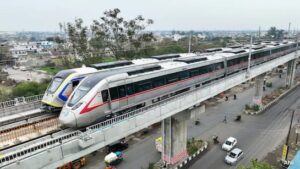
The project was launched in 2019 by the National Capital Region Transport Corporation (NCRTC) and has been gradually opened in phases since October 2023. The final stretch — including the remaining sections in both Delhi and Uttar Pradesh — was completed in early 2026.
Once fully operational, the corridor slashes travel time between Sarai Kale Khan (Delhi) and Modipuram (Meerut) to under 60 minutes, compared with the typical 1.5–2 hour journey by road.
Designed for a top speed of 180 km/h and an operational speed of up to about 160 km/h, the Namo Bharat trains will serve 16 stations across its route, including key hubs such as Anand Vihar, Ghaziabad, Sahibabad, Modinagar, and Meerut South.
The Meerut Metro — India’s Fastest Metro Network
Alongside the RRTS, the Meerut Metro was also inaugurated on the same corridor — a first-of-its-kind integration where a metro system shares infrastructure with a semi-high-speed intercity rail line.
Operating primarily between Meerut South and Modipuram, the metro covers its ~21–23 km stretch in approximately 30 minutes, with 12–13 stations en route, including Bhaisali, Partapur, Rithani, and Meerut Central.
With a maximum operational speed of about 120 km/h, it is now billed as India’s fastest metro system, surpassing even the Delhi Airport Express Line’s top speed of 110 km/h.
Engineering Feat and Integrated Transit Design
The RRTS and Metro corridor represent a significant engineering achievement. The NCRTC had to traverse dense urban landscapes, building elevated viaducts, underpasses, bridges, and multi-modal transit hubs to ensure a seamless high-speed experience.
The Sarai Kale Khan station — one of the newly commissioned stations — has been developed as a multi-modal transportation hub, providing direct connections to Hazrat Nizamuddin Railway Station, Delhi Metro’s Pink Line, Veer Haqeeqat Rai ISBT, and Ring Road bus routes for smooth last-mile connectivity.
A noteworthy innovation of this system is the shared infrastructure design that allows both rapid intercity trains and metro services to operate efficiently on the same corridor. This approach not only saves construction costs but also promotes integrated regional and urban travel — a model that could be replicated in other metropolitan regions of India.
Passenger Experience and Amenities
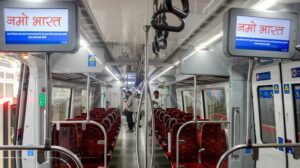
The new Namo Bharat and Meerut Metro services promise a modern and comfortable commute. The trains and stations incorporate advanced safety and convenience features, including:
- Air-conditioned carriages optimized for passenger comfort.
- CCTV surveillance, platform screen doors, and universal accessibility options such as lifts and wheelchair spaces.
- Automated passenger information systems, dynamic route maps, and ergonomic seating for long-distance commuter comfort.
Additionally, fare structures and scheduling are designed to make the service competitive with other travel options in the region, further encouraging a shift from road travel to sustainable public transport.

Impact and Future Prospects
The full launch of the Delhi–Meerut Namo Bharat Corridor marks a pivotal step in transforming regional mobility across the National Capital Region (NCR). Within just a few years of phased operations, the system has already reshaped commuting patterns, attracting thousands of daily riders and allowing many to live farther from Delhi while working or studying there.
By drastically cutting travel times and reducing dependence on private vehicles, the project is also expected to alleviate road congestion, lower vehicular emissions, and promote sustainable urban growth — contributing to broader environmental and economic goals.
Importantly, the corridor showcases how integrated transit planning, flexible engineering, and forward-looking infrastructure investment can spur urban development while improving the quality of life for millions of commuters. Public transport experts suggest the framework of shared RRTS and metro tracks could serve as a template for other cities across India as urbanization accelerates.
Conclusion
The inauguration of the Namo Bharat RRTS corridor and Meerut Metro on 22 Feb 2026 — spearheaded by Prime Minister Narendra Modi — stands as a milestone moment in India’s public-transport history. By combining high-speed intercity travel with ultra-fast metro service, the project paves the way for a future where cities and suburbs are connected in minutes rather than hours, fostering regional integration, economic vitality, and sustainable mobility for generations to come.
You May Also Read: Riteish Deshmukh Unveils Powerful First Look of Raja Shivaji on Shivaji Jayanti