



Digital News Guru Current Affairs Desk:
Diwali Inscribed on UNESCO’s Intangible Cultural Heritage List
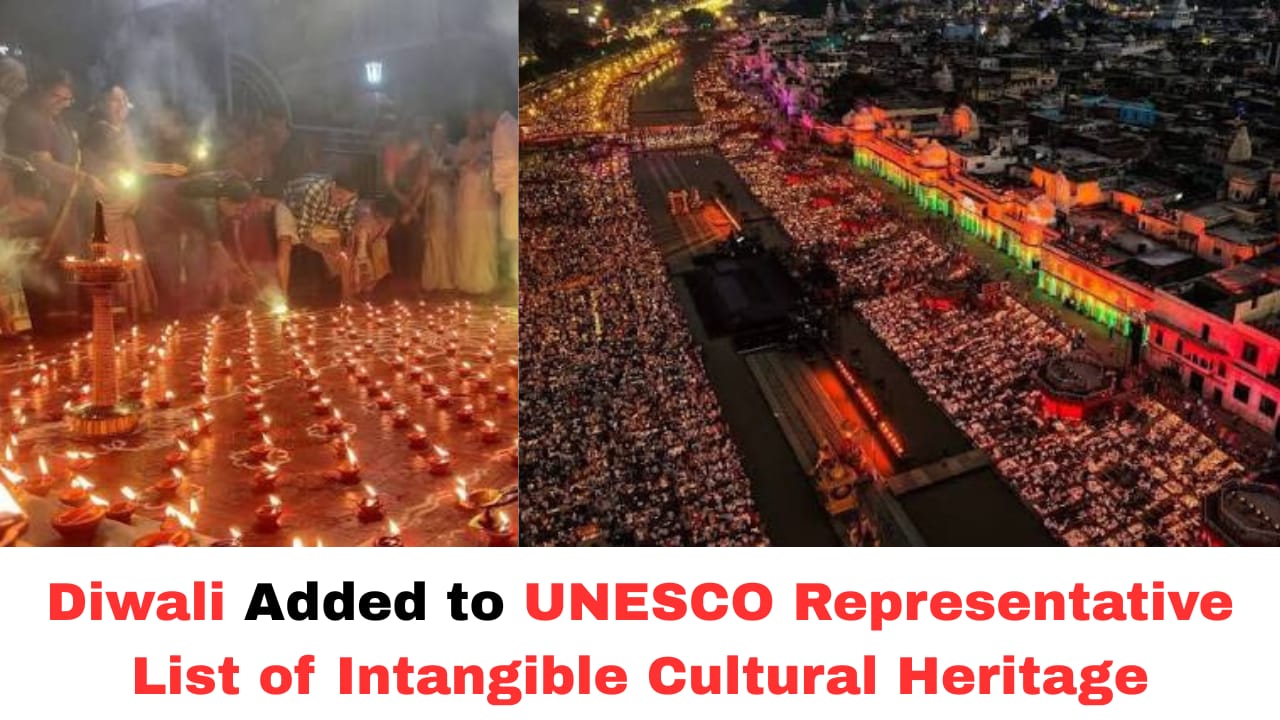
In a momentous cultural achievement, Deepavali — widely known as Diwali — has been officially inscribed on the United Nations Educational, Scientific and Cultural Organization’s (UNESCO) Representative List of the Intangible Cultural Heritage of Humanity. This announcement, made during the 20th session of UNESCO’s Intergovernmental Committee for the Safeguarding of the Intangible Cultural Heritage, marks a significant milestone for India’s cultural heritage being recognised globally.
The festival’s inclusion on UNESCO’s prestigious list reflects decades of sustained cultural practice, community celebration, and shared values that transcend borders — emphasising not only India’s rich traditions, but also the universal message that Diwali carries for people around the world.
What the UNESCO Listing Means
UNESCO’s Intangible Cultural Heritage list recognises cultural traditions, rituals, festivals, and practices that are actively maintained and perpetuated by communities over generations. Unlike heritage sites — which preserve physical landmarks or monuments — this list focuses on living heritage — cultural expressions that continue to evolve yet remain rooted in community memory and participation.
The decision to inscribe Diwali under the “Social practices, rituals and festive events” domain underscores its role as a living tradition that brings people together — not just during the celebrations themselves, but through the transmission of values, stories, and social cohesion from elders to younger generations.
UNESCO’s official description of Deepavali highlights it as a communal celebration tied to the lunar calendar, marking the last harvest of the year and symbolising the victory of light over darkness and good over evil. The festival is celebrated across India and by Indian communities worldwide with rituals such as decorating homes, lighting diyas (oil lamps), offering prayers, exchanging sweets and gifts, and gathering with family and friends.
India’s Growing Cultural Footprint
With Diwali’s inscription, India’s count of intangible heritage elements recognised by UNESCO has risen to 16. These already include globally recognised traditions such as Yoga, Durga Puja, Kumbh Mela, Ramlila, and Garba — each reflecting the diversity and depth of India’s cultural landscape.
The inclusion of Diwali adds another dimension to this list — highlighting not just a single community practice, but a festival that unites millions across religions, regions, and even continents. It reflects a vibrant cultural fabric characterised by pluralism and shared human experiences.
Political and Cultural Reactions
The announcement has been met with widespread celebration across India and among the diaspora. Prime Minister Narendra Modi described the decision as a “proud moment” for the nation, saying that people in India and around the world are “thrilled” by the global recognition. He emphasised that Deepavali is “very closely linked to our culture and ethos” and represents “the soul of our civilisation,” adding that the inscription would further enhance the festival’s global popularity.
Union Culture Minister Gajendra Singh Shekhawat hailed the recognition as a historic day for India’s cultural heritage, praising the festival’s universal message of hope, harmony, and resilience. He expressed gratitude to UNESCO and to the communities that have kept this tradition alive through generations.
In Uttar Pradesh, Chief Minister Yogi Adityanath underscored the symbolic importance of the recognition, particularly for Ayodhya, where the tradition of celebrating Diwali holds deep historical significance tied to the epic narrative of Lord Ram’s return to his kingdom. He described the UNESCO listing as a global validation of India’s rich cultural heritage and a source of pride for communities worldwide.
Cultural and Social Impact
The inclusion of Diwali on UNESCO’s list is not just symbolic — it carries practical implications for cultural preservation and promotion. By elevating the festival to the status of living heritage, the listing encourages efforts to safeguard its traditions against the pressures of modernisation, climate challenges, and social change. It also reinforces the importance of intergenerational transmission — ensuring that future generations can continue to celebrate, interpret, and adapt this rich tradition in contemporary contexts.
Diversity within Diwali celebrations itself — ranging from Deepavali in the south to Kali Puja in eastern India, Govardhan Puja in parts of the north, and regional customs found across states — highlights how a single festival can maintain core values while accommodating local expressions. This adaptability is a hallmark of intangible heritage.
The recognition also bolsters India’s soft-power influence. Cultural heritage listings help shape global perceptions, attract tourism, and foster cross-cultural dialogue. As nations increasingly value heritage diplomacy, UNESCO inscriptions become key tools for nations to project identity and values in international arenas.
Looking Ahead
Diwali’s inscription comes at a time when India is hosting the 20th session of UNESCO’s heritage committee — a symbolic occasion that brought global attention to cultural safeguarding efforts. Delegates from around the world convened in New Delhi’s historic Red Fort — itself a monumental symbol of India’s historical legacy — to review nominations and uphold heritage protection norms.
The recognition has also sparked interest in nominating other Indian traditions for global heritage status. Practices like Chhath Puja, a major harvest festival celebrated in parts of northern and eastern India, are expected to be proposed for future consideration, reflecting the dynamic and evolving nature of India’s cultural expressions.
Conclusion
The inscription of Diwali on UNESCO’s Representative List of the Intangible Cultural Heritage of Humanity is a defining moment — a celebration of India’s cultural depth and enduring traditions. Far from being a static recognition, it symbolises a living legacy that connects communities, inspires hope, and bridges generations. As celebrations continue and new global audiences discover the festival’s rich tapestry, Diwali’s glow — both literal and metaphorical — will shine ever brighter on the world stage.
You May Also Read: Minda Corporation gets 23 Acre Plot near Yamuna Expressway