



Digital News Guru National Desk:
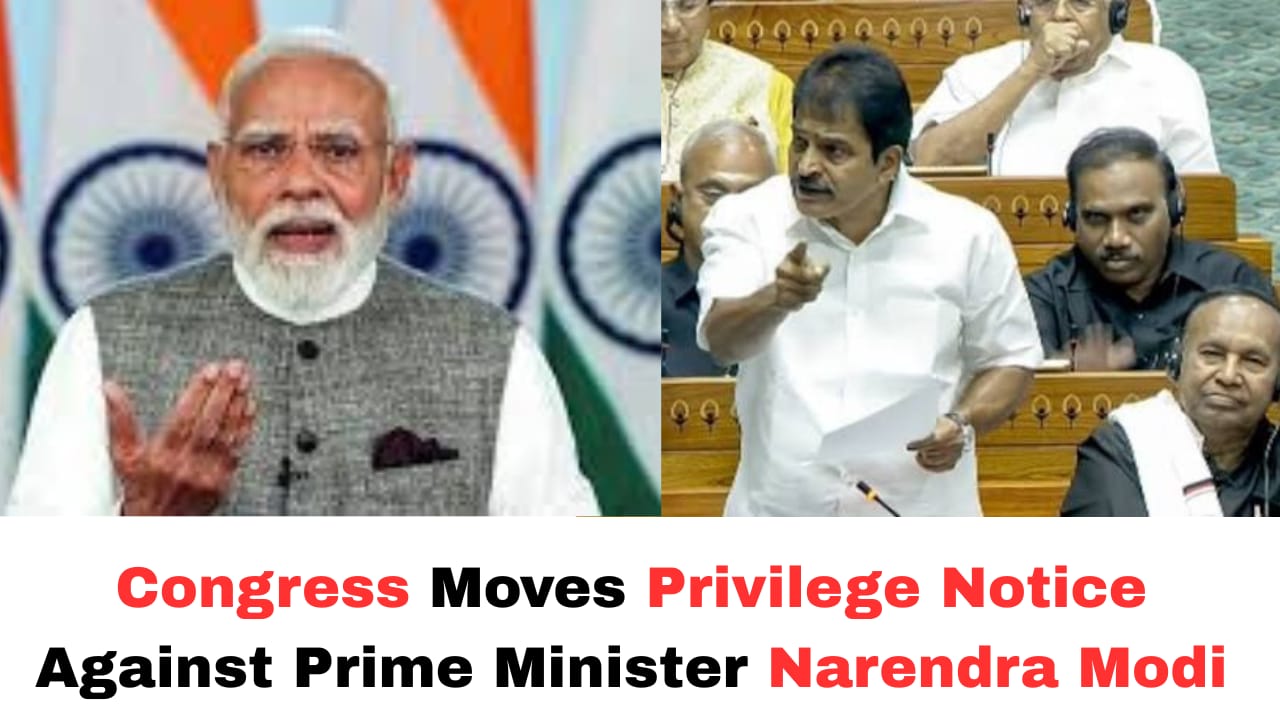
The recent decision by the Indian National Congress to move a privilege notice against Prime Minister Narendra Modi has sparked a new political confrontation in India. The development has once again brought into focus the delicate balance between executive communication and parliamentary norms, raising questions about the limits of political speech and the sanctity of legislative processes.
What Triggered the Controversy?
The controversy stems from a recent national address delivered by the Prime Minister following the defeat of a key constitutional amendment bill in Parliament. In his speech, Modi criticised opposition parties for blocking the legislation and reportedly referred to the voting behaviour of Members of Parliament (MPs), attributing motives to their decisions.
The Congress party has taken strong exception to these remarks, alleging that the Prime Minister’s statements misrepresented parliamentary proceedings and undermined the dignity of elected representatives. Acting on these concerns, senior Congress leader K. C. Venugopal submitted a privilege notice in the Lok Sabha.
Understanding the Privilege Notice
A privilege notice is a formal mechanism available to MPs when they believe their rights, privileges, or immunities have been violated. Parliamentary privilege exists to ensure that legislators can perform their duties freely, without fear of intimidation, external pressure, or public misrepresentation.
If the Speaker of the Lok Sabha admits the notice, it may be referred to the Privileges Committee, which examines the matter in detail and recommends appropriate action. Such notices are serious instruments and are not invoked lightly, as they directly relate to the functioning and dignity of Parliament.
Congress’s Allegations
The Congress has described the Prime Minister’s remarks as a “breach of privilege” and a “blatant abuse of power.” According to the party, Modi’s speech:
- Cast aspersions on MPs by questioning their intent and integrity
- Mischaracterised the parliamentary debate and voting process
- Used a national platform to politically target opposition members
The party argues that MPs have a constitutional right to vote according to their judgment and conscience, and any attempt to publicly question or delegitimise their choices undermines democratic principles.
The Legislative Context
The issue is closely tied to the defeat of a proposed constitutional amendment bill, which reportedly aimed to bring significant reforms, including expanding parliamentary representation and strengthening provisions related to women’s participation in legislatures. The bill failed to pass as it did not secure the required two-thirds majority in Parliament.
Its defeat has clearly intensified political tensions, with the government blaming the opposition for obstructing reform, while opposition parties argue that the bill lacked consensus and adequate deliberation.
Political Repercussions
This development has escalated the ongoing confrontation between the ruling Bharatiya Janata Party (BJP) and the Congress-led opposition. It reflects a broader trend in Indian politics where disagreements inside Parliament increasingly spill over into public discourse.
For the ruling government, the Prime Minister’s address can be seen as an attempt to communicate directly with citizens and highlight what it perceives as obstruction by the opposition. For Congress, however, the issue is about protecting institutional norms and ensuring that parliamentary proceedings are not selectively interpreted or politicised outside the House.
The clash also underscores the growing importance of narrative-building in modern politics, where speeches, media messaging, and public perception play a crucial role alongside legislative action.
Constitutional and Democratic Questions
At the heart of this controversy lies a fundamental question: where should the line be drawn between political expression and parliamentary propriety?
India’s democratic framework allows robust debate and criticism, both inside and outside Parliament. However, parliamentary privilege is designed to ensure that lawmakers can function without undue pressure or misrepresentation. When senior executive leaders comment on parliamentary actions, especially in a public address, it raises concerns about whether such statements could influence public perception in ways that affect institutional integrity.
Legal experts often point out that privilege notices must be carefully evaluated to avoid misuse for political purposes, while also ensuring that genuine violations are addressed effectively.
What Happens Next?
The next step depends on the decision of the Lok Sabha Speaker. The Speaker will examine whether the notice meets the criteria for admission. If accepted, it could be referred to the Privileges Committee for investigation.
The committee’s findings could range from dismissing the complaint to recommending corrective or disciplinary measures. However, such cases often take time and may also be influenced by the broader political environment.
Broader Implications
This episode highlights the evolving dynamics of India’s democracy, where institutional boundaries are continually tested by political competition. It raises important questions about:
- The role of the executive in commenting on parliamentary matters
- The protection of MPs’ rights and privileges
- The need for maintaining trust and credibility in democratic institutions
At a time when public trust in institutions is critical, such controversies can have far-reaching implications beyond immediate political gains.
Conclusion
The privilege notice moved by the Congress against Prime Minister Narendra Modi is more than just a political dispute—it is a reflection of deeper tensions within India’s democratic framework. While disagreements between the government and opposition are natural in a vibrant democracy, the manner in which these disagreements are expressed and resolved plays a crucial role in shaping public confidence in institutions.
As the matter unfolds, the focus will remain on how constitutional mechanisms handle the issue and whether it leads to greater clarity on the boundaries between political communication and parliamentary privilege. Ultimately, the strength of India’s democracy lies in its ability to uphold both accountability and institutional respect, even in the face of intense political rivalry.
You May Also Read: Election Commission Warns of Strict Action on EVM Tampering Ahead of Polls