



Digital News Guru Uttar Pradesh Desk:
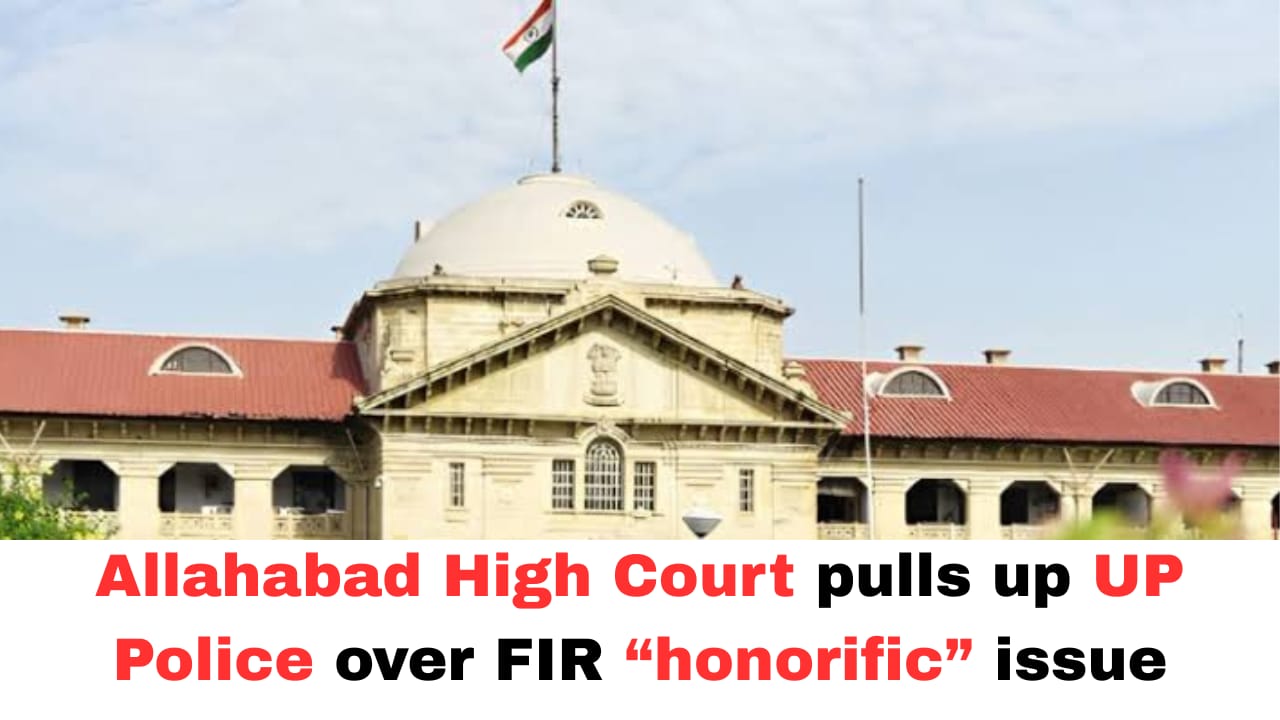
Allahabad High Court pulls up UP Police
In a development that has sparked discussion in legal and administrative circles, the Allahabad High Court has strongly questioned the Uttar Pradesh Police over a seemingly minor but significant lapse in an official document. The issue revolves around the omission of honorifics while mentioning a Union minister’s name in a First Information Report (FIR), raising broader questions about protocol, institutional discipline, and respect for constitutional offices.
Background of the Case
The matter came before the High Court during the hearing of a petition filed by an accused seeking the quashing of an FIR registered in Mathura district. The case involves allegations of fraud, criminal breach of trust, and intimidation. According to the complaint, the accused allegedly took around 80 lakh from the complainant under the pretext of arranging a government job and later failed to return the money.

In the FIR, the name of a Union minister was mentioned because the accused allegedly claimed connections with the minister to gain the complainant’s trust. Importantly, the minister is not an accused in the case but was referenced in the narrative of events.
However, what caught the court’s attention was not the substance of the allegations, but the way the minister’s name was recorded in the FIR.
The Controversy: Missing Honorifics
The High Court observed that the Union minister’s name was written without any honorific prefix such as “Hon’ble” or even a basic courtesy title like “Mr.” In one instance, the minister was referred to only by name, without any formal designation.
A bench comprising Justices J.J. Munir and Tarun Saxena took serious note of this omission. The judges emphasized that while the original complaint filed by a citizen may not follow formal conventions, it is the responsibility of the police to ensure that official documents adhere to proper protocol and standards.
The court remarked that even if the informant did not use appropriate titles, the police, while preparing the FIR, should have corrected the lapse by adding the necessary honorifics.
Court’s Observations and Directions
The High Court’s observations went beyond a simple procedural correction. It underscored the importance of maintaining decorum and respect in official records, particularly when referring to individuals holding constitutional positions.
The bench directed the Additional Chief Secretary (Home), Government of Uttar Pradesh, to file an affidavit explaining why the established protocol was not followed.
The court also pointed out that such omissions reflect negligence in official functioning and could undermine the dignity associated with public offices. The next hearing in the matter has been scheduled for April 6, 2026.
Why Honorifics Matter in Official Documents
At first glance, the absence of words like “Hon’ble” or “Mr.” may appear trivial. However, in legal and administrative systems, language carries weight. Official documents such as FIRs are not merely records of complaints; they are formal instruments that may be scrutinized in courts, used in investigations, and referenced in legal proceedings.

The use of honorifics serves multiple purposes:
- It reflects respect for constitutional and public offices
- It maintains uniformity and professionalism in documentation
- It ensures clarity in identifying individuals and their positions
The High Court’s intervention highlights that adherence to such conventions is not optional but part of institutional discipline.
Broader Implications for Policing
This case also brings into focus the quality of FIR drafting by police authorities. Courts in India have repeatedly emphasized that FIRs must be:
- Accurate
- Clear and legally sound
- Prepared with due diligence
Errors or omissions in FIRs can have serious consequences, including misinterpretation of facts, procedural complications, and challenges in court.
By questioning the UP Police in this case, the High Court has reinforced the need for better training and awareness among police personnel regarding documentation standards and legal protocols.
Administrative Accountability
Another important aspect of the case is the court’s insistence on accountability at the highest administrative level. By directing the Additional Chief Secretary (Home) to explain the lapse, the court has signaled that such issues are not merely clerical errors but systemic concerns that require attention from senior officials.
This approach reflects a growing trend in judicial oversight, where courts seek to ensure that governance standards are maintained across all levels of administration.
Legal and Public Reactions
The incident has sparked debate among legal experts and the public. Some view the court’s intervention as necessary to uphold institutional respect and discipline, while others argue that excessive focus on honorifics may divert attention from more substantive issues in policing and justice delivery.
Nevertheless, the consensus remains that official records must meet a certain standard of professionalism, and lapses—however small—should be addressed promptly.
Conclusion
The Allahabad High Court’s observations in this case serve as a reminder that in governance and law, details matter. What may seem like a minor omission can reflect deeper issues of protocol, training, and accountability.
By taking a firm stand, the court has reinforced the importance of maintaining dignity and precision in official documentation. As the case proceeds, it is likely to prompt introspection within the police and administrative machinery, potentially leading to improved practices in the future.
Ultimately, the episode underscores a fundamental principle: the rule of law is not just about major judgments and landmark cases, but also about the consistent observance of standards—right down to the words used in an FIR.
You May Also Read: Nitish Kumar to Take Rajya Sabha Oath on April 10