



Digital News Guru New Delhi Desk:
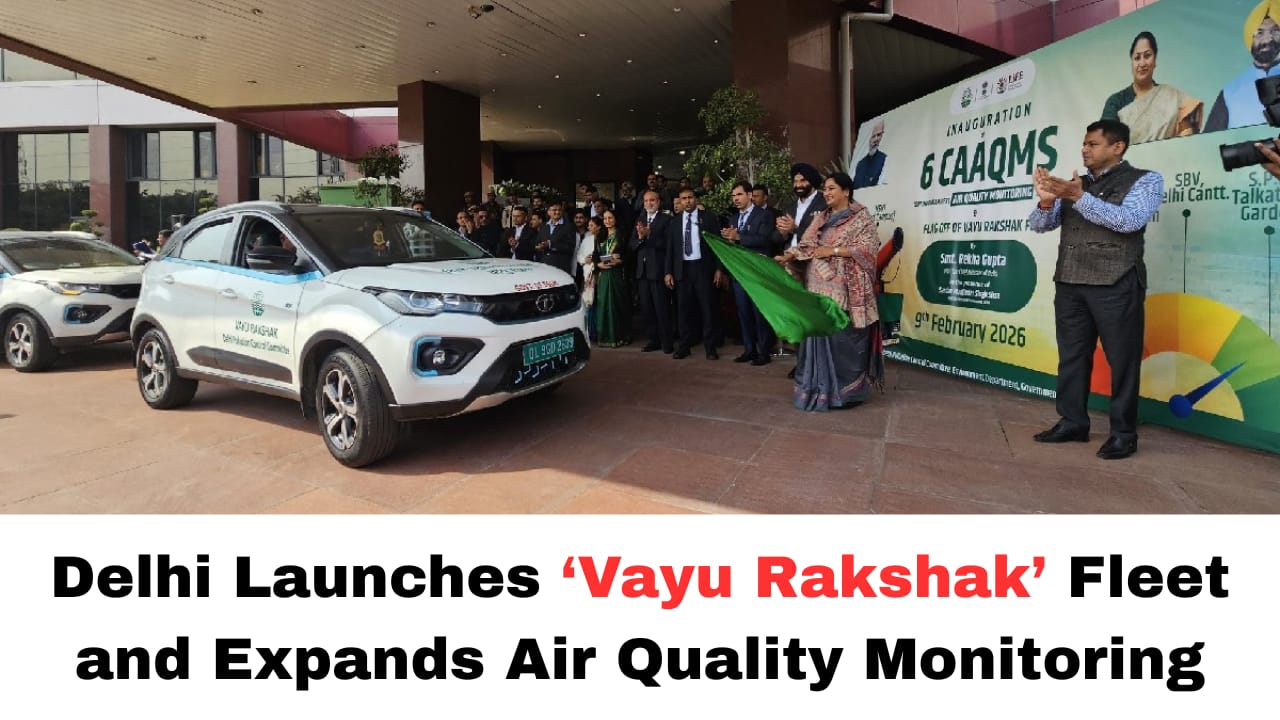
In a significant move aimed at combating air pollution year-round, the Delhi Government, led by Chief Minister Rekha Gupta, on Monday inaugurated six new Continuous Ambient Air Quality Monitoring Systems (CAAQMS) and officially flagged off the Vayu Rakshak fleet — a mobile air-quality monitoring and enforcement initiative. The comprehensive launch signals a shift from traditional seasonal pollution responses toward continuous, data-driven action on environmental health in the national capital.
Air quality remains a persistent challenge for Delhi. Historically, the city’s pollution levels have crossed “poor” and “very poor” categories during peak winter months, affecting respiratory health and daily life. While recent seasonal data shows fluctuating Air Quality Index (AQI) trends, scientific and civic voices alike have underscored the need for constant surveillance and policy action rather than reactive fixes.

What Is ‘Vayu Rakshak’?
Vayu Rakshak — literally “Air Protector” — is a fleet of mobile units deployed across the city to monitor air quality in real time, conduct on-ground checks, and support enforcement actions where pollution norms are violated. This is complemented by the newly installed fixed monitoring stations that continuously feed precise air quality data into a larger environmental management network.
While Delhi already has numerous air quality monitoring stations, the addition of six new CAAQMS — atJawaharlal Nehru University (JNU), Indira Gandhi National Open University (IGNOU), Netaji Subhas University of Technology (NSUT) West Campus, Commonwealth Games (CWG) Akshardham area, Sarvodaya Bal Vidyalaya (SBV) in Delhi Cantt, and the Talkatora Garden — broadens spatial coverage of real-time air data across residential, academic, and strategic zones.
The Vayu Rakshak mobile fleet complements this system by visiting neighbourhoods, gathering air quality information on the ground, detecting pollution sources and notifying enforcement agencies when breaches occur. This enables action not just at fixed points but dynamically across the urban environment.
Government’s Message: A Year-Round Campaign
In her address at the launch event, Chief Minister Rekha Gupta stressed that fighting air pollution cannot be limited to specific seasons. “Pollution is not merely a winter problem,” she said, emphasizing that 365-day monitoring and action are necessary to protect public health and sustain environmental improvements.
The government’s expansion of air quality systems aligns with this broader strategy: providing accurate, granular, and continuous data, enabling officials to not only observe patterns but also tailor public policy and enforcement efforts with scientific precision. The addition of more monitoring stations also moves the total count of such units in Delhi to 46, with further expansion planned.

Environmental and transport officials reaffirmed that these steps — including Vayu Rakshak patrols — are part of a larger, integrated framework for air-quality improvement that extends beyond traditional responses to smog. The initiative underscores real-time data collection, targeted enforcement, and sustained monitoring over corrective but transitory measures.
Why ‘Vayu Rakshak’ Matters Now
Delhi’s struggle with air pollution is multi-faceted. Vehicular emissions, dust from construction and roadwork, industrial outputs, and other sources contribute to high particulate levels — especially in dense residential and traffic corridors. Despite efforts like the Graded Response Action Plan (GRAP) and public transport enhancement, peaks in AQI during colder months continue to disrupt life and health.
The Vayu Rakshak initiative, by deploying mobile monitoring units, aims to fill gaps in spatial and temporal coverage of air quality data. Fixed stations, while valuable, can only provide information for specific locations. The mobile fleet adds flexibility and precision, letting officials detect pollution hotspots as they emerge, rather than retroactively. This dynamic method also supports enforcement — for example identifying unsanctioned burning, construction dust violations, or industrial emissions in near-real time.
Moreover, by integrating mobile data with fixed station inputs, policymakers can make informed long-term decisions on urban planning, transport policies, and environmental regulation. This reflects a newfound emphasis on scientific rigor and technology integration in environmental governance.
Integration with Broader Pollution Strategy
The launch of Vayu Rakshak and new CAAQMS comes at a time when Delhi’s government is pursuing multiple anti-pollution initiatives. Previous plans have included deploying water-sprinkling tankers, anti-smog guns, and promises of expanded electric public transport, alongside stricter vehicular and industrial norms. These efforts underscore the city’s multi-pronged approach to air quality.

Experts note that enhancing monitoring infrastructure is only one piece of the puzzle. Effective pollution control also requires robust enforcement, behavioural shifts among citizens, inter-agency coordination, and regional cooperation with neighbouring states. However, accurate and real-time data — like that from the Vayu Rakshak fleet — is widely acknowledged as a critical foundation for all subsequent action.
Looking Ahead: Challenges and Expectations
While the launch represents a bold administrative push, analysts caution that long-term improvement in air quality will depend on sustained policy actions beyond initial deployments. Consistent enforcement of emissions standards, public transport incentives, and citizen participation are essential to translate data insights into measurable cleaner air outcomes.
Nevertheless, the Vayu Rakshak initiative marks a significant milestone in Delhi’s environmental governance by embedding technology, mobility, and real-time enforcement into pollution management. By broadening monitoring coverage and strengthening on-ground responsiveness, Delhi is positioning itself to better tackle air quality challenges proactively, rather than reactively — a crucial step in safeguarding health and enhancing urban resilience.
Summary: With the Vayu Rakshak fleet and six new monitoring stations, Delhi has expanded its air quality surveillance network and introduced dynamic enforcement capabilities — reflecting a comprehensive shift toward sustained pollution management and data-driven environmental protection.
You May Also Read: Pati Patni Aur Woh Do: Release Postponed, New Date Confirmed