



Digital News Guru National Desk:
Prada’s Bold Step: Luxury Kolhapuri-Style Chappals Spark Conversation on Culture, Craft and Commerce
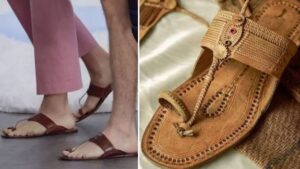
Italian luxury fashion house Prada has set the global fashion world abuzz with its announcement that it will launch a limited-edition line of Kolhapuri-inspired chappals — traditional Indian handcrafted sandals — priced at around Rs 84,000 (~$930 / ~800 €) per pair. The move, which follows months of controversy over cultural appropriation, marks both a strategic branding moment for Prada and a renewed spotlight on centuries-old Indian craftsmanship with potential economic reverberations far beyond the runway.
From Fashion Week to India Collaboration
The story began earlier this year, when Prada showcased a pair of sandals at Milan Fashion Week that closely resembled traditional Kolhapuri chappals — iconic Indian leather footwear known for their distinctive weaving, toe ring, and hand-stitched finish. While the design drew immediate attention, it also triggered criticism in India for failing to credit the cultural roots of the inspiration, with many artisans and commentators calling the act cultural appropriation rather than appreciation.

In response to this backlash, Prada opted for a different approach: collaboration rather than inspiration alone. On December 11, 2025, the company signed a Memorandum of Understanding (MoU) with two Indian government-backed leather industry bodies — LIDCOM (Sant Rohidas Leather Industries and Charmakar Development Corporation Ltd) and LIDKAR (Dr Babu Jagjivan Ram Leather Industries Development Corporation Ltd) — with the aim of developing a “PRADA Made in India x Inspired by Kolhapuri Chappals” project.
This MoU was formalised at the Consulate General of Italy in Mumbai on the sidelines of the Italy–India Business Forum, underscoring the diplomatic and cultural significance of the initiative. The official collaboration is intended to ensure that the heritage of Kolhapuri chappals — a craft with roots in Maharashtra and Karnataka — is authentically represented, while also empowering local artisans through training and global exposure.
What the Limited-Edition Collection Entails
Under this collaboration, Prada plans to produce about 2,000 pairs of Kolhapuri-inspired sandals, each handcrafted using traditional techniques by skilled artisans from the Kolhapur region and neighbouring districts. The footwear will be a fusion of traditional Indian techniques and Prada’s signature design elements and materials.
The collection — priced at around Rs 84,000 per pair — will launch globally in February 2026, both in approximately 40 select Prada stores worldwide and on the brand’s official online platform. This pricing reflects the position of the product as a luxury fashion statement rather than a mass-market item, which has in turn sparked lively debate in Indian public discourse.
Economic and Cultural Impact
One striking outcome of this collaboration is the spotlight it has shone on the economic potential of traditional crafts as global export products. Union Commerce Minister Piyush Goyal welcomed the partnership, stating that Kolhapuri chappals could one day become a $1 billion-a-year export category, reflecting not just the quality of the craft but the worldwide appetite for authentic artisanal goods.
Goyal’s comments highlight a broader opportunity: as global luxury brands seek authentic cultural narratives, Indian handicrafts could gain unprecedented visibility and economic opportunity. With the right support in training, design development, and market access, traditional crafts such as Kolhapuri chappal-making could help bring more artisans into international value chains and uplift rural livelihoods.
Training and Craft Preservation
Crucially, Prada’s engagement goes beyond mere branding. As part of the agreement with LIDCOM and LIDKAR, the luxury house has committed to a three-year training programme designed to enhance artisans’ skills and preserve traditional methods. This includes not only local programmes in India but also short residencies at Prada’s Academy in Italy, where selected artisans will receive exposure to new techniques and global fashion ecosystems.
Prerna Deshbhratar, Managing Director of LIDCOM, praised the initiative as a “sustained dialogue” that honors generations of craftsmen who have preserved Kolhapuri shoe-making through centuries. The collaboration is seen as an “ethical partnership” that gives artisans due credit and respects the lineage of the craft — a marked shift from earlier perceptions of cultural misstep.
Public Reaction: Mixed and Animated
Public response in India has been lively and mixed. On social media, users have poked fun at the high price tag — equating it humorously with common local phrases — but many also raised serious questions about how much of the proceeds will benefit the actual artisans making the sandals. Some critics argue that leveraging a traditional craft for luxury branding raises questions of equity and fair compensation.

At the same time, many commentators appreciate the broader international recognition and the opportunity for Indian artisans to reach new markets. They view the partnership as a potentially positive outcome of a controversy that might otherwise have gone unresolved.
A Turning Point in Fashion and Global Cultural Dialogue
Prada’s move from controversy to collaboration offers a case study in how global brands can responsibly engage with traditional cultures. By focusing on partnership, credit, and economic inclusion, the project may help redefine how fashion houses interact with the cultural and historical origins of their inspirations. This initiative underscores an increasingly important principle in global fashion: that cultural heritage should be celebrated with acknowledgment and shared benefits, not just aesthetic extraction.
As the world awaits the formal launch in February 2026, the global fashion community — and Indian artisans — will be watching closely. This fusion of Italian luxury with Indian tradition could become not just a product, but a symbol of responsible global collaboration, opening doors for other indigenous crafts to enter the international spotlight with dignity, respect, and economic opportunity.
You May Also Read: Twinkle Khanna Explains Why She Kept Her Maiden Name After Marriage