



Digital News Guru National Desk:
Jaishankar Attends State Funeral of Bangladesh’s Khaleda Zia
In a significant diplomatic engagement, India’s External Affairs Minister Dr. S. Jaishankar arrived in Dhaka on Wednesday to represent the Government and people of India at the funeral of Begum Khaleda Zia, the former Prime Minister of Bangladesh and long-time chairperson of the Bangladesh Nationalist Party (BNP). Jaishankar’s visit underscores India’s respect for a key South Asian leader and reflects efforts to maintain strong relations with Bangladesh during a sensitive political period.
Farewell to a Prominent Leader
Begum Khaleda Zia, who died at the age of 80 after a prolonged illness, was a towering figure in Bangladeshi politics for decades. As the first woman to serve as Prime Minister of Bangladesh, she led the country in multiple terms and played a central role in its democratic evolution following years of military rule. Her funeral attracted massive crowds, with thousands of mourners lining the streets of Dhaka to pay their last respects.
The funeral ceremonies were held near the Parliament Building’s South Plaza and Manik Mia Avenue, where state honours were accorded amid a period of national mourning declared by the interim government. Khaleda Zia’s final rites marked the culmination of a political era, as she was laid to rest beside her husband, former President Ziaur Rahman, in Sher-e-Bangla Nagar.
India’s Official Representation
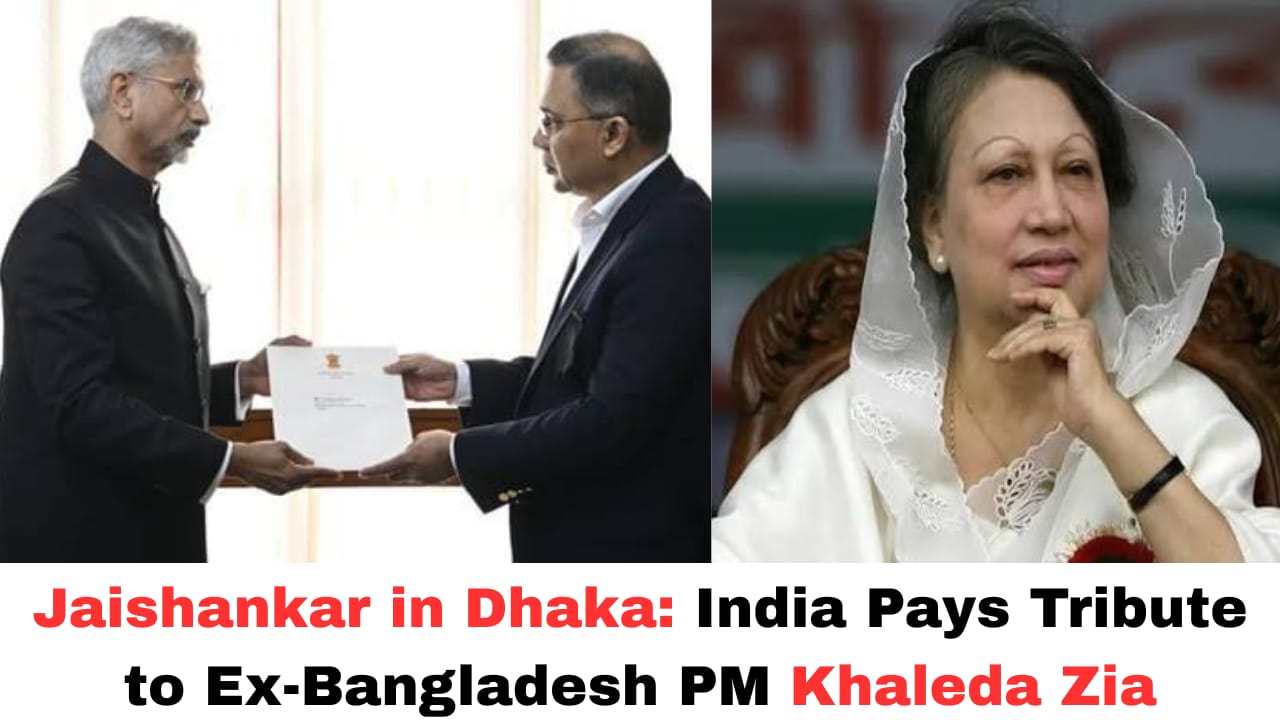
Dr. Jaishankar’s presence in Dhaka was part of India’s official delegation to the funeral. On arrival, he met prominent figures including Tarique Rahman, the BNP’s acting chairman and Khaleda Zia’s son, and conveyed a condolence letter from Indian Prime Minister Narendra Modi. The letter expressed India’s deep sympathies over Zia’s passing and highlighted her contributions to Bangladeshi political life.
Jaishankar’s engagement went beyond ceremonial duty; he personally handed the letter to Tarique Rahman, reflecting diplomatic goodwill and India’s sensitivity to Bangladesh’s internal political dynamics. In his communications, Jaishankar reaffirmed respect for Zia’s legacy and optimism about strengthening India-Bangladesh cooperation in the future.
Prime Minister Modi’s Condolence Message
Back in New Delhi, Prime Minister Narendra Modi expressed profound sadness at Khaleda Zia’s death, recalling his meeting with her during an earlier official visit to Dhaka in 2015. Modi emphasized Zia’s role in shaping Bangladesh’s development and conveyed hope that her vision would continue to inform bilateral ties.
Modi’s tribute highlighted the shared history and cultural proximity between India and Bangladesh, even as political currents shift in Dhaka ahead of elections scheduled for early February 2026.
Diplomatic Context and Regional Implications
Jaishankar’s participation in the funeral carries significance beyond paying respects. It comes at a time when India-Bangladesh relations have faced strains, particularly after a transition in Dhaka’s political leadership and concerns over minority protections and democratic norms. His visit is seen as an effort to reaffirm India’s engagement and support for constructive dialogue with Bangladesh, despite recent diplomatic differences.
Khaleda Zia’s legacy is complex. While celebrated for her role in restoring democracy after years of military rule, her tenure was also marked by political rivalry, notably with Awami League leader Sheikh Hasina, and challenges including allegations of corruption and administrative controversies. Her death during a politically charged period has heightened the symbolic importance of Jaishankar’s visit.
The interim government, led by Chief Adviser Muhammad Yunus, declared a three-day period of national mourning and mobilized significant security arrangements for the funeral. Leaders and representatives from over 30 countries, including Pakistan, Nepal, Sri Lanka, Bhutan, and the Maldives, joined the ceremonies, indicating Khaleda Zia’s stature as a regional stateswoman.
Public and Political Reaction
In Bangladesh, the funeral drew huge crowds, with citizens from across the country converging on Dhaka in a demonstration of both respect and the deep political identity Zia inspired. Observers noted that her supporters, often referring to her as the “mother” of the nation, saw her death as the end of a significant chapter in the country’s political narrative.
Political analysts suggest that Zia’s passing could influence the upcoming elections, as the BNP navigates leadership without its long-time figurehead and attempts to consolidate support. Jaishankar’s interactions with Tarique Rahman also reflected India’s desire to remain engaged with key political stakeholders as Bangladesh approaches its polls.
A Gesture of Respect and Diplomacy
The role of a foreign minister at a state funeral is both ceremonial and strategic. For India, Jaishankar’s visit served to honour a prominent regional leader and to signal commitment to strengthening bilateral relations at a moment of transition. It also underscores the importance New Delhi places on maintaining robust connections with its eastern neighbour, even amid political disagreements or shifts in leadership.
India and Bangladesh share deep historical, cultural, and economic ties rooted in the liberation era and subsequent cooperation. High-level engagements — whether celebratory or somber — serve as reminders of shared priorities and mutual interests in regional stability, economic partnership, and people-to-people ties.
Looking Ahead
As Bangladesh mourns Khaleda Zia, the political narrative continues to evolve. Jaishankar’s visit can be viewed as part of India’s broader diplomatic efforts to engage respectfully with emerging political landscapes in neighbouring countries, even as it balances concerns over governance and bilateral policy positions.
The funeral brought together leaders and officials from South Asia and beyond, reflecting Khaleda Zia’s influence and the region’s interconnected political environment. In this context, Jaishankar’s presence underscores India’s commitment to diplomacy, dialogue, and respect for democratic legacies in South Asia — an approach that will likely shape engagements with Bangladesh in the months to come.
You May Also Read: Nationwide Strike by Gig Workers on Dec 31