



Digital News Guru National Desk:
In a striking diplomatic exchange at the end of 2025, India has firmly rejected recent assertions by China that Beijing played a mediating role in defusing the May 2025 military confrontation between India and Pakistan, describing the claim as “bizarre” and inconsistent with how the ceasefire was actually achieved. The dispute over this narrative reflects the deeper geopolitical tensions among the three nations and underscores New Delhi’s long-standing policy against third-party intervention in bilateral matters with Pakistan.
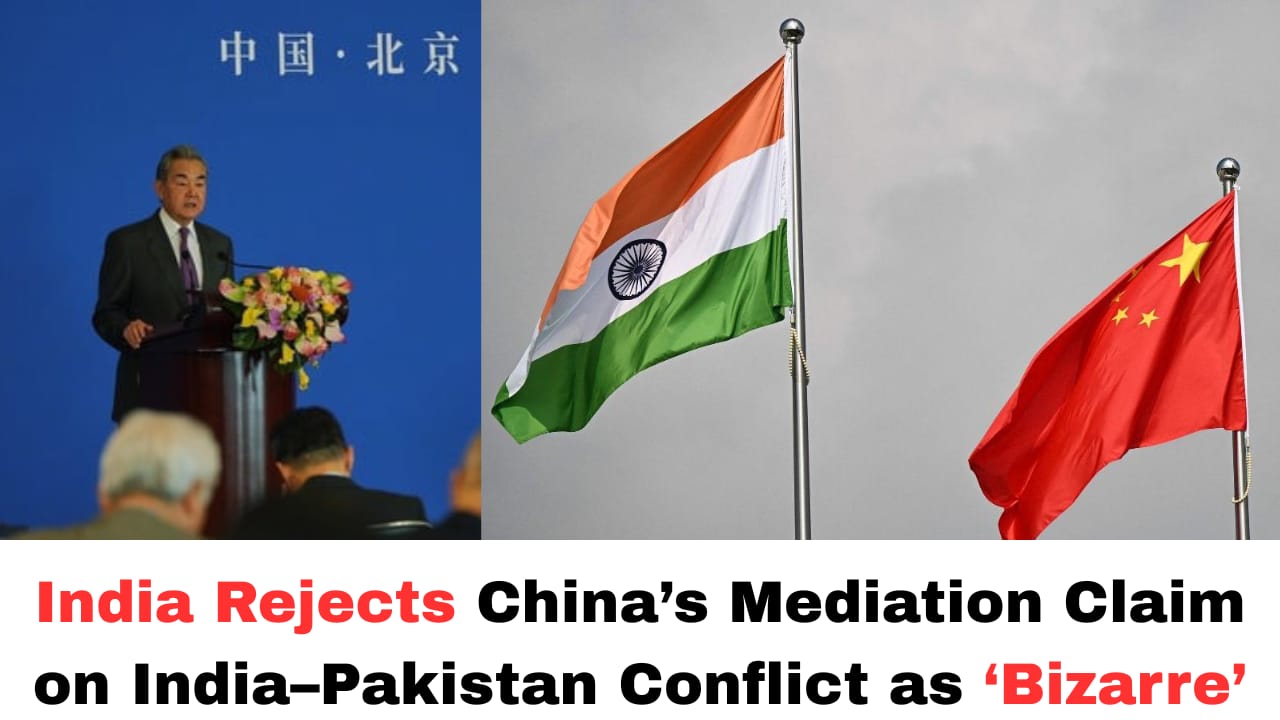
The controversy began when Chinese Foreign Minister Wang Yi, speaking at the Symposium on the International Situation and China’s Foreign Relations in Beijing, claimed that China had mediated several international conflicts in 2025 — including tensions between India and Pakistan. In his address, Wang portrayed Beijing as a proactive “peace-builder” in a world beset by rising local wars and cross-border conflicts, saying that China had helped resolve flashpoints from northern Myanmar to the Israeli-Palestinian situation, and including the South Asian standoff.
However, India swiftly dismissed the narrative. Government sources in New Delhi reiterated that the ceasefire reached on May 10, 2025, following the intense four-day confrontation triggered by the Pahalgam terror attack, came about through direct military-to-military communications between the Directors General of Military Operations (DGMOs) of India and Pakistan — with no external party’s involvement whatsoever. The Ministry of External Affairs pointed out that the specifics of the understanding, including the precise date and time, were worked out solely between the two military leaders on the phone.
India’s position, long clear in official policy, is that third-party mediation has no place in its bilateral security issues with Pakistan — a stance consistently reiterated in past diplomatic cycles and reiterated again in reaction to Wang’s remarks. New Delhi’s formal response emphasized the country’s consistent historical approach: matters with Pakistan must be addressed directly and without interference.
Describing China’s claim as “bizarre,” Indian officials and sources familiar with the issue argued that Beijing had no role in brokering an end to the hostilities that followed Operation Sindoor — the Indian military action in retaliation for the terrorist attack that killed 26 civilians in Jammu & Kashmir in April 2025. They underscored that Indian and Pakistani military officials themselves initiated and agreed to the ceasefire, reaffirming India’s policy on sovereignty and mutual resolution.
Why China’s Mediation Claim Matters
China’s foray into claims of mediation on the India–Pakistan conflict is significant on multiple fronts. For Beijing, it appears to be part of a broader attempt to bolster its image as a global peacemaker and diplomatic intermediary — much as former U.S. President Donald Trump had previously asserted a role in the same 2025 crisis, a claim India also rejected. By aligning its diplomatic branding with conflict resolution in hotspot regions, China may be seeking enhanced influence on the global stage.
Yet in South Asia, China’s strategic relationship with Pakistan is well-established. Beijing is Pakistan’s largest defence supplier, with Chinese arms making up a significant share of Islamabad’s military hardware. Indian military officials have in the past suggested that China’s role during Operation Sindoor extended beyond neutral diplomacy, alleging that Beijing’s support for Pakistan included surveillance cooperation and equipment supplying, though such characterizations have been met with denial by China.

This backdrop makes Beijing’s mediation claim particularly contested; India’s rebuttal is not just about rejecting an assertion, but also about safeguarding its narrative and strategic autonomy in regional affairs.
Domestic Political Reaction in India
India’s rejection of China’s claim has also sparked domestic political debate. The Indian National Congress, the principal opposition party, criticized the central government for not more forcefully addressing the issue and demanded clarity on how China was allowed to publicly assert such a role. Congress leaders argued that accepting or tolerating this narrative could weaken India’s diplomatic position and underscore an imbalance in India–China ties — especially given ongoing concerns over trade deficits, border tensions, and broader geopolitical competition.
The opposition’s criticisms underscore anxiety within segments of India’s political establishment that narratives around major regional conflicts must be tightly controlled, lest they be leveraged by external actors to project undue influence or reshape public perception of India’s diplomatic efficacy.
Broader Geopolitical Implications
The episode occurs against a backdrop of complex South Asian geopolitics, where India, China, and Pakistan each pursue overlapping yet divergent interests. New Delhi’s insistence on bilateral resolution mechanisms reflects its broader pursuit of strategic autonomy and regional stability on its own terms. At the same time, China’s assertion of mediation reflects Beijing’s desire to be seen as a responsible global actor with influence beyond its immediate neighbourhood.
In rejecting the mediation claim, India is also reasserting its centuries-old diplomatic doctrine that foreign mediation, particularly in conflicts involving core security issues, undermines the principle of sovereign decision-making. By doing so, New Delhi hopes to preempt any narrative that could dilute its control over how the conflict’s resolution is viewed internationally.
Conclusion
The dispute over who mediated the May 2025 India–Pakistan conflict has become more than a matter of semantics. It reflects broader contests over geopolitical narratives, regional influence, and the role of major powers in South Asia. India’s categorical dismissal of China’s claim as “bizarre” reinforces its longstanding insistence on direct engagement with Pakistan, without external interference, and signals a firm stance against narratives that could misrepresent its strategic decisions. How this diplomatic row affects wider India–China ties in the coming months remains to be seen, especially as both nations navigate a complex landscape of competition, cooperation, and regional diplomacy.
You May Also Read: Bobby Deol Dubs for Late Father Dharmendra in Ikkis