



Digital News Guru National Desk:
In a landmark moment for the nation, India has officially become the fourth-largest economy in the world, surpassing Japan to claim a position only behind the United States, China, and Germany in global GDP rankings. This remarkable achievement reflects sustained growth over the past decade and signals India’s rising influence in the global economic order.
A Decade of Dynamic Growth
For much of its post-independence history, India’s economy was characterized by slow growth, bureaucratic hurdles and limited global impact. That narrative began to change dramatically in the last ten years, particularly after 2014, when the government embarked on a series of structural reforms aimed at enhancing competitiveness, attracting investment and boosting domestic demand.
Today, India’s GDP is estimated at approximately $4.5 trillion, a figure that places it ahead of Japan’s economy and cements its position as the fourth largest globally. This economic upshift marks a dramatic rise — in just over a decade, India has moved from being the world’s tenth-largest economy to fourth.
How India Overtook Japan
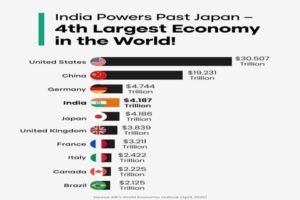
The milestone of overtaking Japan did not happen overnight. According to forecasts from the International Monetary Fund (IMF), India’s nominal GDP was projected to reach around $4.187 trillion in 2025 — just a hair above Japan’s projected GDP of around $4.186 trillion — a shift that propelled India into the fourth spot.
Earlier in the year, India was ranked as the fifth-largest economy, trailing Japan. However, robust economic expansion — driven by domestic consumption, rising exports, and accelerated investment — allowed India to close the gap rapidly. IMF data shows that India’s GDP more than doubled over the past decade, while Japan’s economic growth remained modest in comparison.
Key Drivers Behind the Growth
Several factors have contributed to this momentous rise:
- Strong Domestic Growth
India has consistently registered one of the highest real GDP growth rates among major economies. Even amid global slowdowns, its growth has hovered around 6.3–7%, significantly outpacing developed economies and underlining the resilience and dynamism of its macroeconomic fundamentals.
- Export Expansion
Exports have seen remarkable growth over the last decade, with engineering goods, electronics, pharmaceuticals and services leading the charge. Services exports, in particular, have more than doubled, showcasing India’s competitive edge in sectors such as IT and business services.
- Investment and Reforms
Foreign direct investment (FDI) inflows have surged, crossing $1 trillion cumulatively, reflecting global investor confidence in India’s economic prospects. Government initiatives — such as Make in India, Digital India, and major infrastructure projects — have enhanced ease of doing business and strengthened growth potential.
- Digital and Financial Inclusion
The surge in digital infrastructure, especially the rapid adoption of UPI and digital transactions, has transformed India’s economic landscape. Digital tools have facilitated smoother business operations, greater financial inclusion, and a more formalized economy — all contributing to overall GDP expansion.

Voices from the Leadership
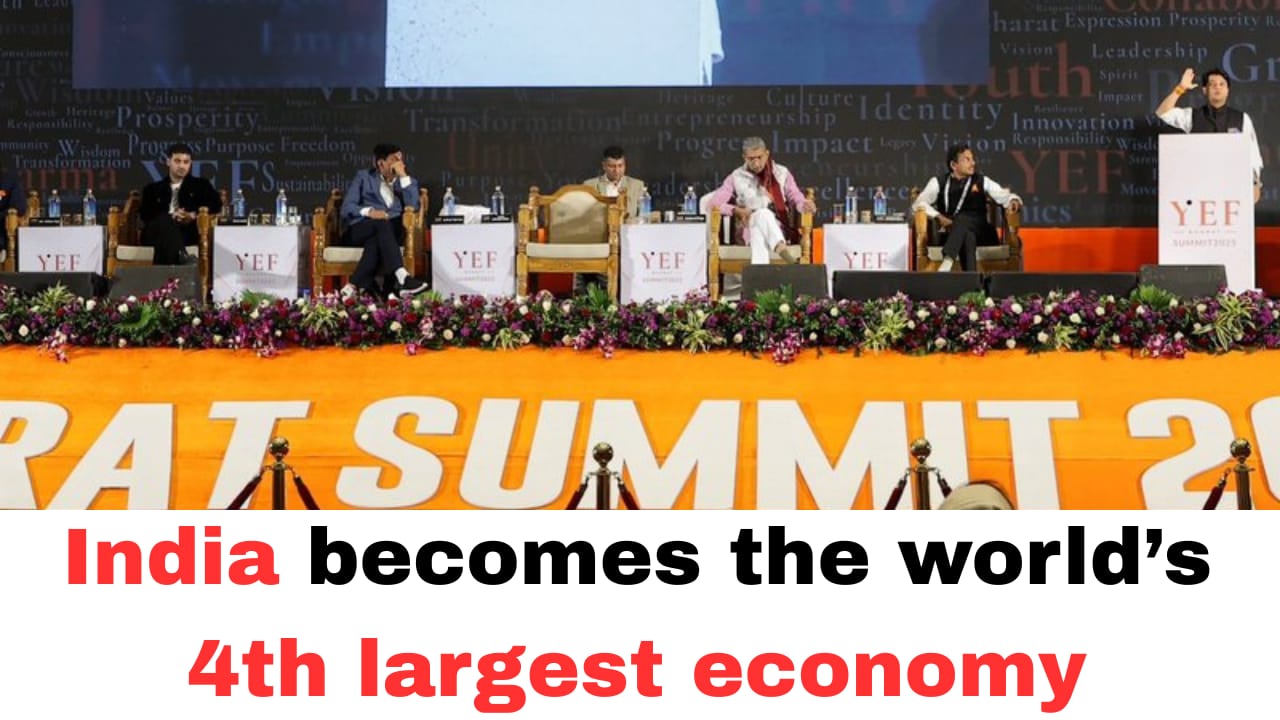
Union Minister Jyotiraditya Scindia, speaking at the Young Entrepreneurs Forum Bharat Summit 2025 in Indore, celebrated this historic achievement and reaffirmed the government’s growth agenda. He noted India’s journey from a relatively smaller economy to a global heavyweight was driven by a combination of policy reforms, entrepreneurial energy and strategic global engagement. Scindia further projected that India could surpass Germany to become the world’s third-largest economy by 2027 if the growth trajectory continues unabated.
State leaders also highlighted regional contributions. For example, Madhya Pradesh’s growth in sectors such as pharmaceuticals and agriculture demonstrates how local development aligns with national economic success.
Global Context and Strategic Implications
India’s elevation to the fourth spot reshapes the global economic map. A decade ago, India was ranked much lower, emphasizing how rapidly global economic power dynamics can shift. This reordering reflects not just numerical growth but broader geopolitical implications:
- Emerging Market Influence: India’s rising GDP amplifies its voice in global institutions such as the G20 and WTO, giving it greater leverage on trade, climate and development issues.
- Investment Magnet: Multinational corporations have increasingly eyed India as a manufacturing and service hub, diversifying supply chains away from traditional centres.
- Demographic Advantage: With a young workforce and expanding urban middle class, India is positioned to sustain growth through domestic demand — a key advantage many older economies lack.

Challenges Along the Way
While the headline figure is impressive, economists caution that challenges remain. India’s per capita income still trails developed nations, indicating that overall wealth distribution and productivity gains need attention. Structural issues such as labour market reforms, educational quality, and infrastructure bottlenecks will determine how inclusive and sustainable the growth is over the long term.
Additionally, global uncertainties — including trade tensions, geopolitical risks, and climate change pressures — may influence future growth paths. Strategic planning will be essential to manage these external shocks while continuing to expand GDP.
The Road Ahead
Becoming the fourth-largest economy is a watershed moment for India — one that reflects decades of policy shifts, entrepreneurial vigour and demographic potential. Yet, the story is far from over. With projections suggesting India could rise to the third largest economy by the end of the decade, the focus now turns to sustaining this momentum, improving living standards, and ensuring that economic success translates into broad-based prosperity across the population.
As India cements its role on the world stage, the narrative of growth is evolving — not just in terms of numbers, but in how the nation engages with global markets, harnesses its demographic dividend, and shapes its own future in an increasingly interconnected economy.
You May Also Read: India Clinch Series with Convincing 30-Run Victory Over South Africa in the 5th T20I