



Digital News Guru New Delhi Desk:
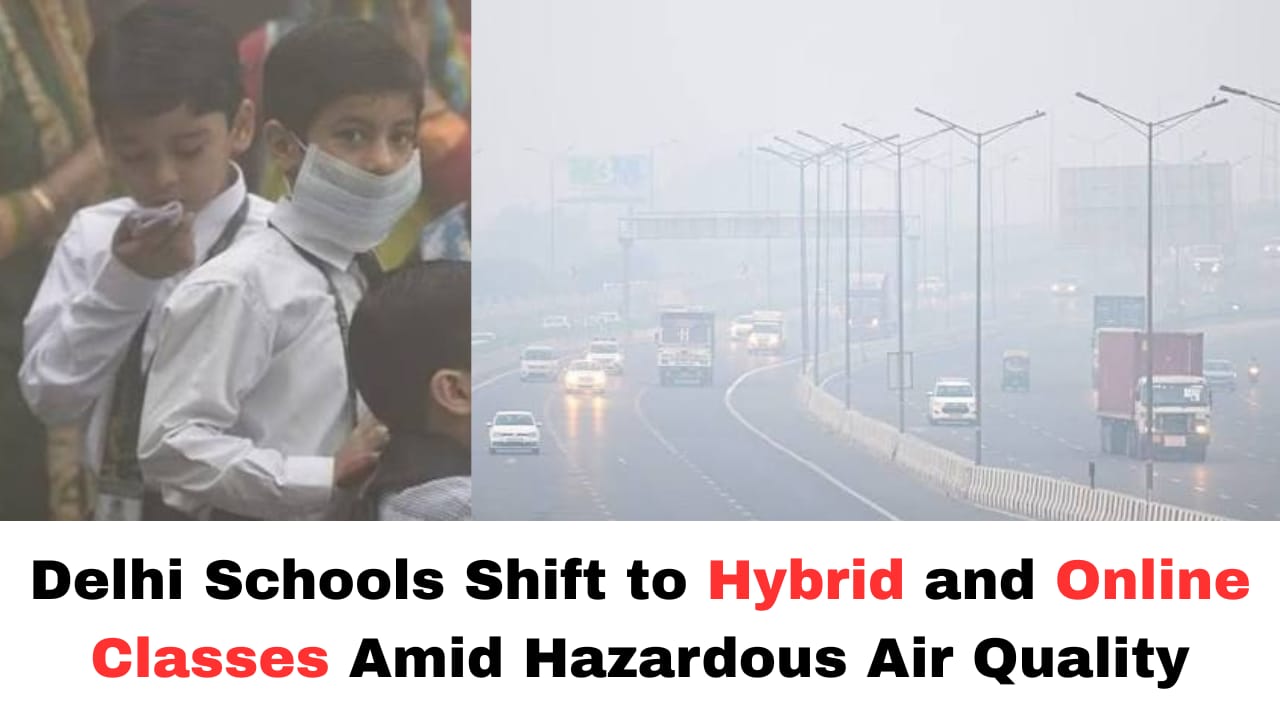
As Delhi grapples with one of the worst air pollution episodes of the season, the Delhi Government has ordered schools to switch to hybrid and online learning modes in a major attempt to protect students’ health. The move comes after air quality across the National Capital Region (NCR) plummeted into the hazardous category, triggering emergency action under the Graded Response Action Plan (GRAP) Stage IV.
Severe Pollution and Health Risks
Over the past week, Delhi’s Air Quality Index (AQI) has surged past the 450 mark at several monitoring stations, indicating severe to hazardous levels of air pollution. The choking smog, caused by a combination of vehicular emissions, construction dust, weather conditions, and regional pollution sources, has posed significant health risks, especially to children, elderly citizens, and those with respiratory problems.
Doctors and public health experts have repeatedly warned that prolonged exposure to such poor air can lead to aggravated asthma, bronchitis, eye irritation, and other respiratory issues in children, whose lungs are still developing. This urgent public health concern has been a key factor in the government’s decision to adjust academic arrangements.
Government Directive: Hybrid & Online Mode for Schools
In accordance with the GRAP Stage IV measures activated by the Commission for Air Quality Management (CAQM), the Delhi Directorate of Education (DoE) issued a circular on 13 December 2025 directing all schools to change the mode of instruction until air quality improves.
Under this order:
- Students up to Class V are required to attend fully online classes only. This ensures that the youngest and most vulnerable children are not exposed to hazardous outdoor air.
- Students in Classes VI to IX and Class XI are to follow a hybrid model—a combination of online and in-person learning wherever feasible. Parents and guardians have the option to keep children fully online if they prefer.
- Classes X and XII typically remain physical due to board exam preparations, but schools are instructed to monitor air quality closely and implement protective measures.
This hybrid approach aims to balance academic continuity with health safety, minimising disruptions to education while ensuring that children are not unnecessarily exposed to toxic outdoor conditions.
Implementation Across Delhi and NCR
The directive applies to all government, government-aided, unaided private schools, and institutions under NDMC (New Delhi Municipal Council), MCD (Municipal Corporation of Delhi), and the Delhi Cantonment Board. Similar instructions have also been issued by district administrations in Noida and Ghaziabad, with students up to Class V switching fully online and older students following hybrid schedules.
In Noida and Greater Noida, authorities specified that mixed mode learning would apply for higher grades, while lower grades continue exclusively online to reduce health risks.
Why Hybrid Mode Was Chosen
Unlike a complete closure of schools, hybrid learning offers academic continuity while significantly reducing students’ exposure to hazardous outdoor air. By combining physical and virtual classrooms, schools can maintain educational progress and also protect children’s health. This decision reflects a growing trend among educational authorities to leverage digital infrastructure in response to environmental emergencies.
The hybrid model also gives parents and guardians flexibility to choose online attendance for their children, ensuring that families can make decisions based on individual health needs and circumstances.
Public and Parental Reaction
The directive has drawn mixed reactions from the public. Many parents have appreciated the proactive measures, especially for younger children, acknowledging the serious health implications of breathing hazardous air. Schools, too, have scrambled to ensure that digital platforms are ready to support smooth online classes.
However, some parents and educators have raised concerns about the digital divide, noting that not all students have equal access to reliable internet or devices required for online learning. This challenge has spotlighted persistent inequalities in educational access, especially among economically disadvantaged communities.
Teachers, too, are adapting to a fluid teaching environment, adjusting lesson plans to suit both online and in-person students. Many schools are deploying supplementary materials and recorded lectures to help students who experience connectivity issues.
Health Precautions and Broader Measures
In addition to shifting learning modes, authorities have also suspended outdoor sports and physical activities across schools in Delhi-NCR. Public advisories have urged residents to stay indoors if possible and to wear protective masks like N95 when stepping outside.
Officials are also monitoring compliance with pollution control measures, including restrictions on vehicles, construction works, and certain industrial activities under GRAP Stage IV. The government has emphasised that these actions are temporary but essential to protect public health.
Context: Delhi’s Pollution Crisis
Delhi’s annual winter pollution episodes are a recurring crisis, driven by factors like temperature inversions, vehicular emissions, construction dust, and crop stubble burning in neighbouring states. Despite efforts to mitigate pollution through legal and administrative measures, the city frequently experiences episodes of hazardous air quality each winter, prompting health advisories and emergency action plans like GRAP.
Air pollution is estimated to contribute to serious health issues, with respiratory diseases and cardiovascular conditions significantly aggravated during peak smog periods. The persistent nature of the problem has also led to public debates on long-term solutions, including stricter emission controls and regional cooperation to address sources beyond Delhi’s borders.
Looking Ahead
Authorities have indicated that the continuation of hybrid and online classes will depend on real-time air quality data. If or when pollution levels improve and the AQI moves back into safer categories, schools may resume normal in-person operations with updated guidelines.
Education experts suggest that the experience of hybrid learning during environmental crises could support more resilient educational systems in the future, enabling students and teachers to transition seamlessly between in-person and remote modes as needed.
For now, Delhi’s school community remains vigilant, prioritising both health and learning continuity amid one of the capital’s most severe pollution episodes in recent years.
You May Also Read: Pawan Singh Begins Shooting for New Film Daanveer in Lucknow