



Digital News Guru International Affairs Desk:
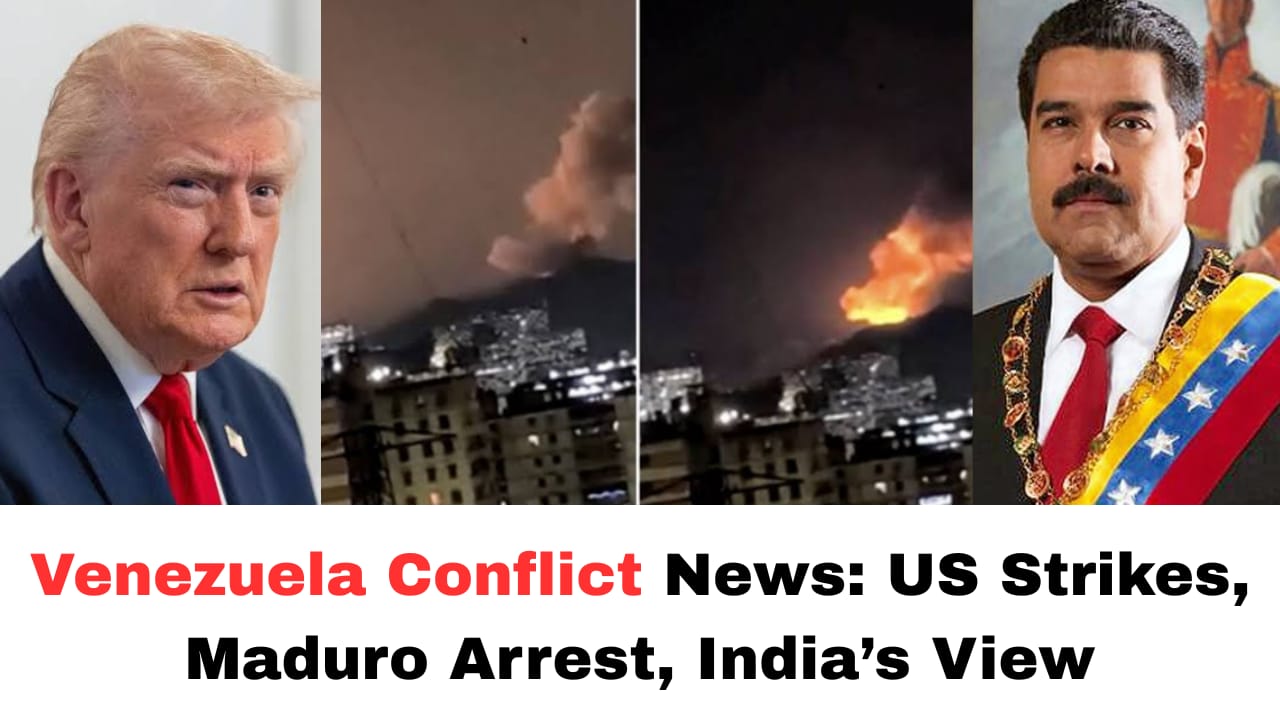
In a dramatic turn of events that has sent shockwaves across global politics, the United States launched a major military operation against Venezuela, culminating in the capture of Venezuelan President Nicolás Maduro and his wife and their transfer to the United States. The strikes and subsequent detention of Maduro have escalated tensions in Latin America and triggered diverse international responses — from outright condemnation to cautious calls for diplomacy. India, for its part, has adopted a characteristically measured stance, emphasizing peace, stability and the safety of its citizens abroad.
Surprise U.S. Military Operation and Maduro’s Capture
On January 3, 2026, U.S. military aircraft conducted air strikes on Caracas and other Venezuelan locales, a move described by the White House as targeting alleged “narco-terrorism” networks and security threats linked to President Maduro’s regime. Following the attacks, Maduro and his wife were reportedly seized by U.S. forces and flown to New York, where the U.S. government intends to prosecute them on charges including drug trafficking and weapons offences. Former U.S. President Donald Trump, overseeing the operation, stated that the United States would temporarily “run” Venezuela to ensure a transition of power and stability.
The operation — one of the most significant U.S. military actions in Latin America in decades — was executed without clear authorization from Congress, provoking intense debate over legality and international norms. Critics argue that the incursion violates the UN Charter’s prohibition of force against a sovereign nation without Security Council approval or clear self-defence justification, a view echoed by international law experts.
Immediate Aftermath in Venezuela
In Venezuela, the government declared a state of emergency following the strikes. Vice President Delcy Rodríguez, constitutionally next in line, was thrust into a contentious interim leadership claim amid confusion and resistance. The political situation remains volatile, with a power vacuum emerging in Caracas as security conditions deteriorate.
The Venezuelan opposition, meanwhile, has welcomed Maduro’s removal. Prominent opposition leader María Corina Machado hailed the event as the start of a “new Venezuela,” promising democratic reforms and the restoration of civil liberties after years of authoritarian rule.
Global Reactions — Deep Divisions Emerge
The U.S. operation has produced starkly divided reactions worldwide, underlining geopolitical fault lines and contrasting visions of international order. Many governments condemned the U.S. action as a flagrant violation of national sovereignty and international law, while a few others supported or expressed cautious understanding.
Countries Opposing the U.S. Operation:
- China strongly denounced the U.S. strike as a violation of international law and a dangerous precedent for infringement on sovereign states, urging restraint and respect for the UN Charter.
- Russia demanded clarification on Maduro’s detention, describing the U.S. action as “armed aggression” and an affront to global norms.
- Iran and Cuba also condemned the attack, labeling it a breach of sovereignty that threatens peace in the region.
- Colombia and some Latin American states criticized the military escalation as destabilizing and perilous for regional security.
Countries Calling for Restraint and Lawful Solutions:
- The European Union urged all parties to uphold international law and avoid escalation, emphasizing diplomacy over military force.
- The United Kingdom also highlighted the primacy of international legal norms in addressing the crisis.
Supporting Voices and Divergent Views:
- Some leaders, including Argentina’s president, praised the removal of Maduro, framing it as progress toward freedom and democratic renewal.
India’s Response — Caution, Concern and Citizen Safety
Amid this geopolitical maelstrom, India has adopted a cautious and pragmatic approach. The Ministry of External Affairs (MEA) has expressed “deep concern” over the U.S. strikes and the unfolding humanitarian and political situation in Venezuela. New Delhi has reiterated its long-standing support for peaceful resolution of international disputes through dialogue and diplomacy, while also emphasising the safety and well-being of the Venezuelan people.
Importantly, India has not issued a detailed political endorsement or condemnation of the U.S. military operation. Instead, it has focused on practical measures to protect its citizens in Venezuela. The MEA has issued an advisory urging Indian nationals to avoid all non-essential travel to Venezuela, exercise extreme caution, restrict movement, and maintain contact with the Indian Embassy in Caracas should they be present in the country.
This neutral posture reflects India’s broader foreign policy principles of non-intervention and respect for sovereignty, while acknowledging the rights of nations to seek peaceful solutions to internal conflicts. It also underscores India’s priority on protecting its diaspora in volatile environments.
Broader Implications — International Law, Oil Politics, and Regional Stability
Beyond immediate reactions, the crisis raises profound questions about international law and the use of force. Legal scholars argue the U.S. operation could set a controversial precedent where powerful states unilaterally intervene in sovereign nations under broad security justifications, potentially eroding the post-World War II security framework enshrined in the UN Charter.
Critics also note that Venezuela’s vast oil reserves, among the largest in the world, may be an underlying factor in global strategic considerations, adding a resource politics layer to the crisis. Some left-wing parties, including major ones in India, have labelled the U.S. action as a bid to control oil assets, intensifying international concern.
Regionally, Latin America now faces heightened instability, with prospects of refugee movements, humanitarian needs and diplomatic tensions rising as a consequence of foreign military intervention and shifting power dynamics in Caracas.
In conclusion, the U.S.–Venezuela conflict marks a defining moment in contemporary geopolitics — a collision of military force, legal debate, and global diplomatic posturing. India’s response, grounded in caution, humanitarian priorities and adherence to dialogue, reflects its evolving yet consistent foreign policy amid complex international crises.
You May Also Read: Cricket Tensions Escalate: Bangladesh Seeks Relocation of T20 World Cup Matches from India