




Digital News Guru Kerala Desk:
The Indian film fraternity is mourning the loss of one of its most imaginative and technically gifted craftsmen. K. Shekhar, the veteran art director renowned for his work in Malayalam cinema — particularly the pioneering 3D film My Dear Kuttichathan — passed away at the age of 72 on Saturday at his residence in Thiruvananthapuram. His death marks the end of an era for a creative mind whose set designs became integral to the narrative and visual identity of many memorable films.
Born and raised in Kerala, Shekhar’s entry into the film industry was humble yet auspicious. After earning a postgraduate degree in journalism from Kerala University in 1979, he stepped into cinema with the role of a costume publicity designer for the ambitious period film Padayottam (1982), which was Malayalam cinema’s first 70 mm production. This early opportunity — on a project noted for its scale and technical ambition — laid the foundation for a decades-long career at the intersection of creativity and technical innovation.

Crafting Cinema’s Visual Language
While many art directors help fill the background of film frames, Shekhar’s work stood out because it actively shaped the visual storytelling. His sets were never mere backdrops; they were environments with character, depth and purpose. Over the years, he collaborated on a range of notable Malayalam films such as Fazil’s Nokkethadhoorathu Kannum Nattu (1984), Chanakyan (1989) and Onnamuthan Poojyam Vare (1986), among others. These films are remembered for their carefully designed visual spaces that seamlessly complemented the emotional and narrative arcs of the story.
Colleagues often described Shekhar as a quiet professional, deeply committed to his craft. His sets combined realism with subtle stylisation, enabling films to feel both grounded and narratively rich without overwhelming the audience with visual excess. This balance is what marked him as one of the most respected art directors of his generation.
The Legacy of My Dear Kuttichathan
Though he contributed to numerous films throughout his career, Shekhar’s most enduring legacy is tied to India’s first 3D film — My Dear Kuttichathan (1984). Directed by Jijo Punnoose and produced by Navodaya Studios, the movie remains a landmark in Indian cinema for its technological innovation and nostalgic charm.
The sequence that etched Shekhar’s name into cinematic history was the design of the iconic rotating room featured in the song “Aalipazham Perukkaan”. This set wasn’t just a visual trick — it was a bold architectural and cinematic experiment. Built as an octagonal structure weighing several tonnes, it was rotated manually to create the illusion of defying gravity, allowing actors to appear as though they were walking on walls and ceilings. The elaborate design and execution captivated audiences and remains celebrated to this day.
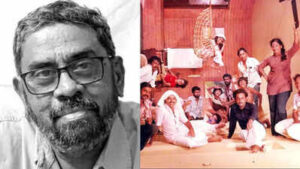
At a time when the Indian film industry was still exploring mainstream 3D technology, Shekhar’s creativity and willingness to embrace complex engineering challenges were instrumental in bringing the director’s vision to life. The rotating room wasn’t merely a set — it was a breakthrough in production design that helped My Dear Kuttichathan transcend conventional filmmaking techniques and offer audiences a spectacle unlike anything they had seen before.
Beyond Cinema: Diverse Contributions
Shekhar’s talent wasn’t limited to feature films. Over the years, he also worked in television, contributing to projects such as the Hindi serial Bible Ki Kahaniyan, which aired on Doordarshan and brought biblical narratives alive through thoughtful visual settings. This expansion into television underscores his versatility and adaptability to various storytelling formats.
In addition, Shekhar’s design work extended beyond the screen. He was involved in spatial and themed design, including contributions to projects like the Kishkinta amusement park in Chennai — an indicator of how his artistic sensibilities could translate into physical spaces experienced by the public outside cinema halls.
Industry Reaction and Personal Remembrance
News of Shekhar’s passing has elicited an outpouring of respect and reflection from peers, filmmakers and art directors who recognised his impact on the craft. Many have lauded his quiet dedication, technical skill, and the thoughtful care he brought to each project. His work is frequently cited in film schools and production design discussions for the way it elevated visual storytelling.
Despite the technical innovations he helped pioneer, those close to him remember Shekhar as a humble man who cared deeply about the art of cinema. He was passionate about designing environments that served the story first — a philosophy that earned him admiration from directors, cinematographers, and production teams alike.

Final Rites and Legacy
Shekhar is survived by his wife, Jayanthi, a commerce teacher. His body was laid out for public viewing at his residence before the last rites were conducted at Thycaud Shanthikavadam, marking the final farewell to a luminary of Indian cinema.
As the industry reflects on his contributions, it’s clear that Shekhar’s influence will linger — not just in the iconic images he created, but in the generations of filmmakers and designers inspired by his work. From an ambitious 70 mm film in the early 1980s to the groundbreaking 3D spectacle that defined a generation of cinema-goers, his career spanned transformative decades in Indian filmmaking.
Remembering K. Shekhar
In remembering K. Shekhar, cinema honours not only a dedicated artist but a visionary whose passion for immersive visual storytelling helped elevate Indian films to extraordinary heights. His legacy is preserved in the enduring magic of the worlds he designed — where imagination and craft united to create unforgettable cinematic moments.
You May Also Read: Vikram Bhatt and Wife Shwetambari Denied Bail Again in Rs 30 Crore Fraud Case