



Digital News Guru National Desk:
Centre Orders Ban on New Mining Leases in Aravalli Range
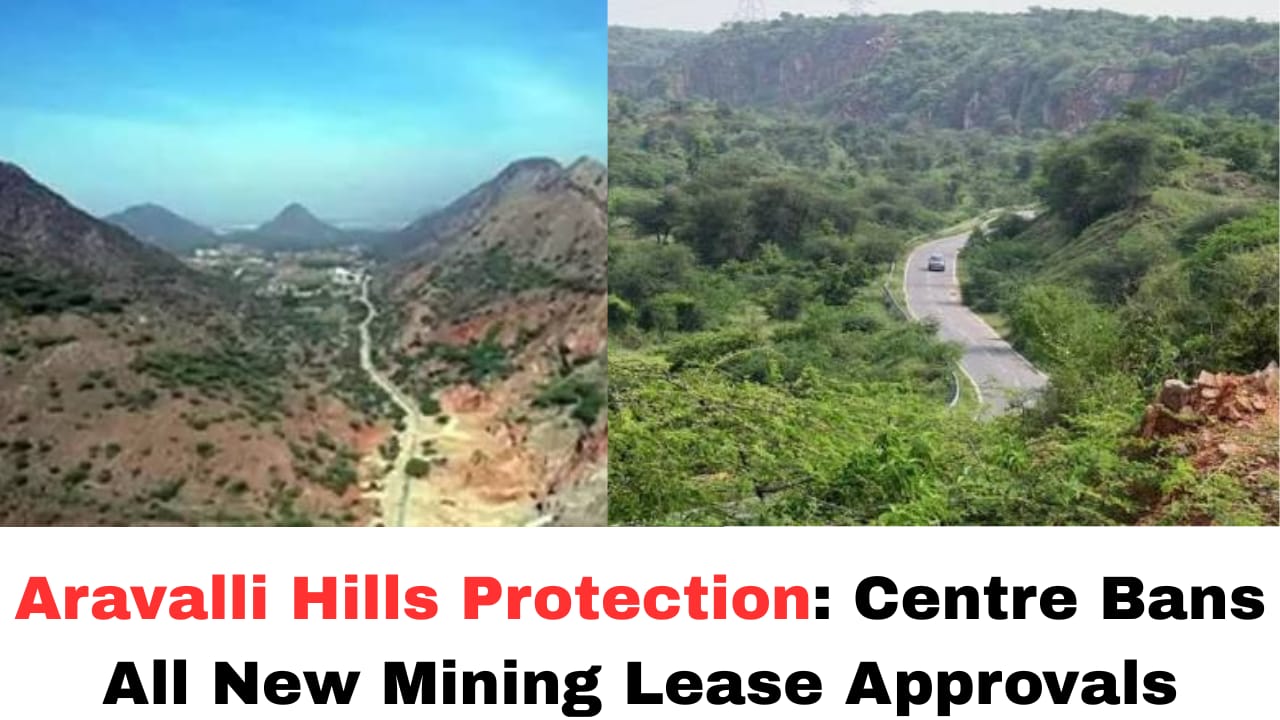
The Union Ministry of Environment, Forest and Climate Change (MoEF&CC) has directed all states to impose a complete ban on granting new mining leases anywhere in the Aravalli Range — the ecologically sensitive mountain system stretching from Gujarat to the National Capital Region (NCR).
This direction is aimed at curbing illegal and unregulated mining that has long threatened the fragile ecosystem of the Aravallis, which play a key role in preventing desertification, conserving biodiversity, and recharging groundwater aquifers.
What the Ban Covers
- The ban covers all parts of the Aravalli hills and ranges, spanning Delhi, Haryana, Rajasthan, and Gujarat.
- States have been instructed not to grant any new mining leases within this landscape until further notice.
- The ministry has also asked the Indian Council of Forestry Research and Education (ICFRE) to identify additional zones across the range where mining should be prohibited, expanding protection beyond already restricted areas.
Scientific Planning and Long-Term Conservation
As part of the directive, the government has tasked ICFRE with preparing a comprehensive Management Plan for Sustainable Mining (MPSM) for the entire Aravalli region. This science-based plan will evaluate:
- Ecological carrying capacity
- Cumulative environmental impacts
- Conservation-critical zones that must remain off limits
- Measures for landscape restoration and rehabilitation
The draft plan will be placed in the public domain for consultation with stakeholders before finalisation.
Background: Why This Decision Now?
The decision follows years of concern over rampant and often illegal mining in the Aravalli hills, particularly in Rajasthan and adjoining states. A november 2025 Supreme Court ruling accepted a uniform legal definition of the Aravalli Hills and Aravalli Ranges — a move meant to help enforce protection and curb mining in areas previously ambiguously classified.
Environmental activists, scientists, and local communities have stressed that unregulated mining has contributed to:
- Soil erosion and habitat loss
- Lowered groundwater tables
- Air and noise pollution
- Threats to flora and fauna endemic to the range
The government’s new directive seeks to address these concerns by pausing new mining approvals until a clear, sustainable strategy is in place.

What Happens to Existing Mines?
Mines that are already operational will continue under strict environmental regulation, with state governments required to enforce:
- Compliance with environmental safeguards
- Adherence to existing Supreme Court orders
- Additional restrictions as needed to ensure sustainable practices
This ensures that while new leases are banned, current operations do not proceed in a way that further degrades the fragile ecosystem.
Reactions to the Ban
- Environmentalists and activists have broadly welcomed the ban as a positive development for conservation efforts, though many emphasize that enforcement and scientific planning will be crucial.
- Political responses have been mixed: Opposition leaders like Congress have called the move “damage control,” arguing that deeper structural issues — such as the new definition of what qualifies as Aravalli land — still need to be addressed for the protection to be meaningful.
- Regional leaders and officials from states like Haryana have endorsed the ban and criticised attempts to politicise environmental protection.

Why It Matters
The Aravallis are among the oldest mountain ranges in the world and serve ecological functions that extend far beyond their physical footprint:
- They moderate climate and air quality across North and West India.
- They support diverse wildlife and plant species.
- They form a crucial water recharge zone for aquifers supplying major cities, including Delhi.
Protecting them from unchecked mining is seen as vital for long-term environmental stability and sustainable development in the region.
Next Steps
- ICFRE will undertake the scientific survey and draft the Management Plan for Sustainable Mining, expected to guide future policy.
- States will implement the ban uniformly, while monitoring and enforcement mechanisms are strengthened to prevent illegal operations.
- Public and stakeholder consultations will help refine the protections and balance ecological needs with economic and social interests.
In summary
The Central government has issued a directive banning all new mining leases in the Aravalli Range to protect one of India’s most ecologically sensitive landscapes from further degradation. The move pairs environmental protection with scientific planning, emphasising a comprehensive strategy to sustain the hills’ natural functions and biodiversity in the long term.
You May Also Read: Dharma Productions Denies Plagiarism Allegations on Homebound